The Sanctity of Each Individual.

Once again, this weekend we have seen the horrible and tragic evidence of what happens when people cannot control themselves or get along. In this world, it seems we only have ourselves and each other. And for us to use survives and thrives as a species we must do more than battle with each other over words and ideals.

I’m not saying that ideals and words serve no account. I am saying that until we learn to talk in common and peaceful discourse, we are our own worse and most violent threat to our existence.

We are smart people, living our beliefs and dedicated to our causes. And yet, if we don’t learn to live with each other in civility, men with rockets and bombs that can reach the West Coast will do little compared to the destruction that we will do to ourselves.

We must all work towards the common good knowing the importance and the sanctity of each individual.

More Than We Can Handle?

Have you ever watched jugglers? Jugglers start off with three of whatever they are juggling. So if they are juggling bowling pins, or balls, or even bowling balls, they always seem to have one in each hand and one in the air. Of course the better they become as jugglers, they still only have two hands, but rather than having a total of three items to juggle, they may have four, five, or six various items. This means many more items in the air and a higher chance of missing something.

And of course, the more items the juggler has in the air, the more likely it is that what will happen? Yep, something happens and all the items being juggled fall to the floor.

The juggler will tell you dropping things is part of growing and stretching their ability. To grow as jugglers, they have to understand that they will drop objects while they are learning. And, they will drop objects while they expand their reach. They know that is part of growing as a juggler.

I believe in growth. I believe in stretching one’s abilities. Although not a large proponent of multitasking, to a large degree, I do know that this is an important talent.  One sought after today in the marketplace.

I noticed that if I’m multitasking various issues at the same time, one of them gets the majority of my attention and the rest during that moment have cursory attention. Does this mean that I will miss things? Will I drop things? Could something end up going undone? Sure, I’m only human. Surprisingly enough the same can be said of all humans who juggle or multitask.

We do not drop items on purpose, although it will, at some time, happen.  At times, in business, we all need to juggle. We and the people we work for take that chance. The trick is…

Not to Take On More Than We Can Handle At A Given Time.

I Am Under Construction

First off, I have to apologize for not being with you the first two days of this week and for that I am truly sorry. I know that the largest part of everything is to be there. I promise you that I will work hard to ensure daily blogs are there when you’re ready to read them.


Not as an excuse or reason for not being here, rather something good that hopefully affects all of us, I am now taking courses to help me with the work I do for you. These courses will hopefully help me to make better learning modules, better blogs, and to be able to share more information on those things which you are interested in hearing about.


In the meantime, I will keep the blog going daily Monday through Friday, and as time goes on, I will keep you updated on the how the training is going.


One thing I can mention now is that I’ll be doing some interviews in the next week or two to learn about to learn more about you and how I can better help you. The interviews are for gathering information they are not sales calls nor will I sell anything while talking with you on information calls. I am just an old scholar learning new ways. But the key thing there is learning. For most people, it’s learning the new that keeps you young.


If you would like to participate in the interviews, please let me know in the comments section, and we should be able to connect and set up a time and date it’s mutually agreeable.


Thank you for putting up with me, and starting tomorrow will be back to looking at neat and interesting things.


Be The Person You Want Helping You

Lately, I have read a lot from many entrepreneurs about which is more important, to make a lot of money or to help the client who needs that help?

This is a fair dilemma. If you don’t help people and do good for them or their companies you really can’t make very much money because you will not have many customers. If you spend all your time helping people giving away most of what you do and not making a sufficient income, you will not be able to continue due to a lack of funds.

This reminds me of a similar debate in manufacturing. To provide the customer what they are paying for, the winds need to build quality products. To earn sufficient funds to pay for the lines running, asserting quantity must be built and shipped to the customer.

Poor quantity means not enough product to satisfy the customer or keep the line running. On the other hand, poor quality means returns, reworks, and loss of reputation.

Let’s  look at this in action. You have a young line with new builders who have only the most minimum of training. The manufacturing manager steps on the line and tells everyone they will build and package 350 units by the end of the shift, or else she will find new people to build her computers.

The new people, needing the jobs to support their families and themselves are terrified and start doing whatever they can as fast as they can. Quality inspectors, who work for the manufacturing manager (poor choice in organizational structure) are letting all but the most serious of errors through inspection believing if the units are bad they will fail at the testing stations.

Although it’s a squeaker, the 350 units are built and shipped by the end of the shift. Everybody feels elated. Even the manufacturing manager has something on her face, although it’s not sure if what people saw was a smile, or sneer. Alas, this is just the start of the story and not the happy ending. The units shipped have a myriad of flaws, and the customer believes some units have major flaws which require repair before the units can be sold on the open market.

The 350 questionable units are shipped back to the United States from Europe and with 400 units that were built but not shipped underwent re-inspection and repair. When planning the economics of the line, a re-inspection and repair of units at this magnitude were never contemplated. The factory now has to pay for transportation of units, storage of units, a work crew to inspect and repair units, certification of the work by the customer’s inspectors, and re-shipment back to Europe. This is what we call a hidden factory. It’s not something you plan for your factory to do. Not something you’re going to get paid extra for. It is just a drain on the resources of the factory.

Let’s move this back to our question of the day and are we out to help people, or are we after the big bucks.

If you help someone, hopefully, they tell a friend. And if you help their friend, they’ll tell someone else, maybe two. If you build a quality product and put it in a quality program and charge a fair price, you may go far. Doing good things for people grows a following.   

If your product is filled with errors, grammatical problems, ideas that are irrelevant to the reader you may find items being returned and fees requested to be refunded. That is never a good start and is certainly a bad end.

So, what do you do? Do the best that you can make sure your work is relevant to your customer and you go from there.  And…

Be The Person You Want Helping You.

Real Riches Are Never Measured In Money

Have you ever contemplated what work really is? We learned fairly early in life, usually around 11 or 12, that if we go out and do something for somebody, we can get a reward. Five dollars to shovel snow from the walk or to weed a garden. Fifteen to 20 dollars to cut the yard depending on size. And as we grow little, babysitting money.

Even at a young age, these small jobs can be big bucks. Young, smart entrepreneurs can easily maintain a list of five or 6 yards to cut in a weekend earning them $75 to $100.

As we grow older, we can then hire the neighborhood kid or our own children for those jobs we do not wish to do ourselves. And then later on when everyone’s grown, once again we find is ourselves doing those jobs with one small catch. No one is paying us. Wait a minute?

Is what we view as a job promotion for a life we spent becoming something else? I don’t think so. Cutting the grass is cutting the grass. A labor of love?  Again, I don’t think so. I would often be happy just to let it grow. Pay the neighborhood kid to do it? Last time I did that, he demanded the money up front for scout camp and then, he never cut the yard.

Side benefits for cutting the lawn? It keeps my significant other from more complaints. And, a good completion, if lucky, may even result in a kiss. Yet, it’s something that still has to be done. You can’t stop grass and shrubs from growing.

We do a lot of things, for rewards that have nothing to do with money. Raising kids is work, and at the same time, it’s a labor of love. The reward is when the children grow into adulthood and find their positive directions in the world.

Taking care of the house is a job. The better you keep it up, the easier the job becomes. When you keep the house like I do you end up with a true work of art. My house is post-modern clutter.

We all have chores we must complete. Chores that are often considered paid jobs to other people. Any chore or job that is done is a direct reflection on the person doing it. If a chore goes undone, is that not also a reflection upon the person in charge and the person who is supposed to complete the chore? This is something to contemplate.

Almost every action you do is an action someone else gets paid for. Chefs cook dinners.  Barbers shave people. Home health care workers wash people. Critics watch movies and TV shows and talk about them. If you’re doing these different occupations, for yourself, you’re working for yourself. And you are giving to yourself what others would be paid. This may not be in the coin of the realm, however, think of the riches you have and those you gain in doing these chores. After all…

Real Riches Are Never Measured In Money.

Are You an Original?

A simple question.   Are you an original or are you a duplicate?

It’s also a silly question, one asked, not to be insulting or demeaning; rather, one to look at considering. And either answer is all right

I am an adult educator and trainer by profession. I am also a writer and an artist. For some of these roles, I’ve done years of extensive schooling. For others, I have either taken other classes or worked with the help of mentors and informal education.

I keep an eye on what’s being talked about looked and taught online. I do this, first, because I need to learn and continue learning. Knowledge continuously changes and grows. I like to keep up with my contemporaries.  I truly believe that online learning, done right, is the best training you can possibly get.   Online learning can fit both into your time and your economic constraints (of these two items, time is the most valuable.)

I look at many offers for classes online, each selling the idea that they have the secret and that if you follow their way of doing things hundreds of thousands of dollars could easily be yours every year.  I have seen some ads which talk about a quick $5000, and others that suggest up to a seven-figure annual earnings.

The interesting part is as you look at their offerings and go to their webinars they start to merge together. Various deliveries give you the same information and lead you to the same actions and conclusions.

This puzzled me at first, then, as I looked at and contemplated this I began to understand. I came up with a plan which was suggested from one of my mentors.

 It works like this; the happiest, richest, and most content people are often those who pick a road early on and stay on it as they walked through life. This is true in religion, it is true in marriage, and it is very true in education. The reason for this is that the alternative to taking all roads at once turns out to be physically impossible and economically impossible. You just can’t do it, and it’s not very productive. Anyone jumping between roads headed towards their destination will find that the changes and costs will keep pulling them back towards the beginning, away from their goals.

If you have a religion that meets your needs, brings you closer to your God, to your beliefs and makes you a better person, follow it. If you have a marriage and children and it looks like a lot of work, that’s okay. Work it. Although things look better elsewhere, the look is just the wrapping on a package of things you don’t even know about yet. If you commit, stick with it. There are hundreds upon hundreds of educators online willing to show you the path to riches and greatness. If you have three or four that you believe in, follow them and stay with them. Jumping between various mentors and trainers can become costly, confusing, and more than taking your money it can steal your time. You can always get money, yet each of us only has so much time and no matter how we use it when it is used it is gone forever.

Yesterday I talked about outliers and the difference between being an outlier and following the crowd. If you wish to be an outlier, don’t be the crowd and don’t be a duplicate.

Be the Outlier…

                                  …Be Original.


OUTLIERS

Despite common belief, outliers are not farmers who were out sleeping in their field. If you are a farmer out lying in your field, you are the exception. Outliers are facts, ideas, people, actions, stocks, figures, and data that are outside the norm.

Most everybody likes to be part of the group. They believe there is safety in numbers, that we all hang together or we all hang separately, and that those who do not follow the norms are weird or eccentric or just need to be avoided.

The truth is a little bit different. If you stand with the group, you are not distinguished from everyone else in that group. When massive layoffs come, the company doesn’t need the group. The company needs a core set of people who perform. It’s hard to distinguish that if you’re hiding in the group.

There is much talk today of many job types going to automation.  Everything from journalists to drivers to construction.  If the job you love is in one of these areas, you want to be the outlier that people cannot do without.

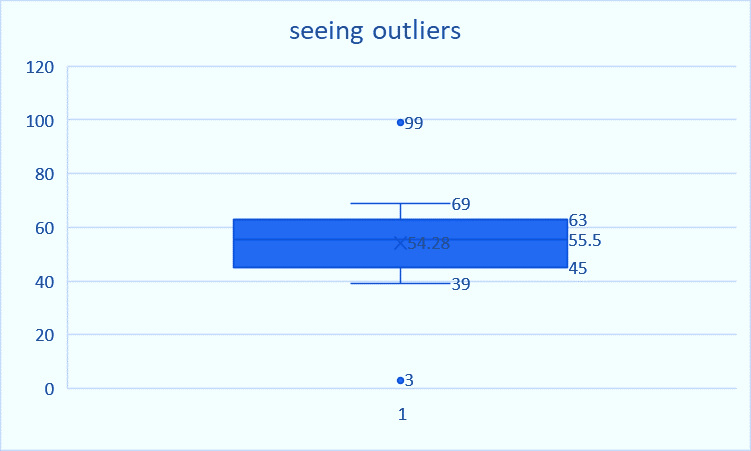
Here is what outliers look like on the chart.

Here is a chart of 100 people ranked as to their reputation at work they do.  The mean rating is 55.5.  The average rating is 54.28.  There are actually 22 people from 39 to 45. On the chart between 45 and 54, there are 30 people.  There are 34 people from 55.5 to 63 and 12 people from 64 to 69.

Seeing outliers


Then there are 2 outliers.  The lower one has a 3, and the upper one has a 99.  If I read this and can keep only an employee or 2, who do you think I’m going to keep? Hire the worker with the 99 rating.

If I am a new company or company whose hiring someone, you think I would hire rating number 57 who is hiding in the middle of the pack, or rating number 99 who is setting the pace?  Who would work for you?

If you don’t think that this is going on today or that it is just a fad, go online and do some research. Look at the TEDx talks, also look at the videos on how Amazon is running at Seattle warehouse.

Uber is testing its driver-less cars now in Pittsburgh, and driver-less trucks are doing well in the West. The trucks could be the norm in some states by the end of the year.

Are you not affected? The driver-less truck never needs to stop for coffee, and a driver-less taxi rarely pulls through a fast food drive-through to pick up a meal.  Who else gets touched by this?  There are positives and negatives in everything.

I do not tell you these things to worry you. I look at these things because it is important for you to prepare for what comes next. Even if the only thing you know right now is there will be change, and you should be ready for a change.  Change is overall a good thing.

The Problem Ranking and Planned Fix Chart

Welcome back we’re glad to have you with us again. If you’re new, we are glad to have you too.

We are looking at various ways we can use process improvement tools in our daily life. If this is your first time joining us, or you joined recently, you may wish to look back at the blogs from June 5 and coming forward. It will give you a better idea of what we are doing.

Yesterday I talked with SAM, and he added to his list. It is below in the form of a chart, and we will get to it in a few minutes. First, though, I need to tell you that what we are going to do today is a highly modified Pareto chart. Pareto charts are usually built on data rather than just anecdotal information.  After we do this for the home, I will also (next week) make a Pareto chart for a work situation so you can see the difference.

For now, how can we take the every day and add quantifying data? It’s not as difficult as it seems. Let’s look at the problems, and next to them (in the chart below) we will add some data I was able to glean for some of them. Remember antidotal problems are still problems. Fixing problems is just easier when you can measure them.

Here are the concerns and what SAM has told me:

  • SAM said that there were snakes in the yard and it was too hot to cut. When I talked to him, he said they had seen eight snakes in the last month. We have data we can use.
  • In winter, there is little heat in the house. We moved that statement to down the list. SAM said it barely gets over 60° in the house during some storms. Now we have data and identification of a health risk due to possible hypothermia. Yet right now it is summer.

I think you get the idea on finding some data for measurements.  There were talks and discussions. The same friends who helped with the affinity chart came over and helped them to think of ideas on how to rank the problems and cure them. For where they were, and what was going on, everyone it is agreed it would be okay to ask for little support.

Talking to others is great. A few neighbors, worried about the lot volunteered to help the next Saturday. Another neighbor had a good mechanic who needed some copywriting done for ads he wanted to run. SAM is working to be a writer. A trade of services could greatly reduce the costs of getting the car fixed. The mechanic got ads, and SAM got to work on a project with his writing skills.

The landlord was invited over for fried chicken dinner that was supplied by SAM, his wife, and his mother-in-law. The landlord appreciated the good-looking lot. All the noise created by everyone working (and being very careful) and making a lot of noise scared away the snakes.

Talking to the landlord, the idea of saving money on the water bill was viewed as a great idea, and he personally came over the next week and replaced all the washers in all the faucets.

Below is the chart that shows the ranked problem areas, the measurement, and the fixes.  As I said this is not the normal use of a Pareto, and I will show you a regular Pareto chart in action, next week.  For now, we will call this chart ‘The Problem Ranking and Planned Fix Chart’

Problem Ranking Problem Data Fix
1 SAM said that there were snakes in the yard and it was too

hot to cut.

Saw eight snakes in the last month. In the early morning next Saturday, the group of neighbors who found out about this problem while talking to SAM will come over and have a house party to help them cut the yard and fix the place up. We thank SAM’s mother-in-law for talking to friends and helping to get this started.
2 Car needs to be fixed Car failed 3 times in one month The car failed to start three times in the last month. That is the problem and the data. This moves to number two on the list. It is now July, and the house heater has until November when it will be truly needed. Lack of transportation isolates people.
3 Money in is less than money out. Income per month is $1500, and pay out to bills is $1750 School debt, minimum-wage, and credit card debt can be put into one item. Money needs are not supported by the wages earned. Add up to everything that must be paid in the month and all the monies that are brought in in a month. If the income is less than the payments required, there is the data.
4 SAM and his wife needing jobs better jobs Quality of life and ability to meet each person’s potential We combined both into one item. This is not a matter of “Gee, I don’t want to work,” it is a matter of them fulfilling their potential. They cannot quit and hold. However, they can seek and find.  With the car fixed, they found good jobs in a medium sized city, just a 15 mile drive each way.
5 House too hot in summer Uncomfortable Their next-door neighbor had 2 fans in the attic doing nothing.  These were loaned to SAM and his wife
6 Too cold in the winter Health Hazard The landlord had the heater inspected, and all the vents cleaned.
7 Poor shopping choices considering the income Too Costly An agreement to stay within a set meal budget was agreed to, and a garden was planted in the now snake free yard.
8 Being overwhelmed Too many problems with not enough ideas SAM and his wife learned many good skills from their friends studying process improvement.  Those skills now serve them at home and at work.
9 Cranky Landlord Scary Everyone responds well to positive communication, collaboration, and a great fried chicken meal.

We will continue tomorrow with how data can help show a hidden factory.

Have a great Day.


We Need a Win-Win Situation

I hope all is going well for you.

Hope you haven’t had some days like I’ve had lately were problems just seemed to ooze out of the woodwork. Not bad problems, just annoyances the little things that can get under your skin and just build up. Sometimes I find myself trying to fight everything at once, and just being overwhelmed. Do you ever have times like that?

Do you ever have times where the car acted up? The wind blows the wind turbine off the house, and there’s a hole in the ceiling? Money gets tight, as the cost of food goes up? The toilet won’t stop running, and the place feels too hot and too cold both in the same day? Cleaning up the messiest room could be easy, yet first, we would have to get the rooms to stop vying for the ‘Messiest Room in the House’ award. Ever get despondent and throw your hands up in the air just not knowing what to do?

I have done this before, and probably most the people reading this have been there. The way I see it, there a few things we can do. We can stay in bed pull the covers up over our head and ignore everything. That means the problems win. We could ignore everything and just walk away. Unfortunately, the problems win again. We could try to tackle all the problems at once, yet, I’m pretty sure they would overwhelm us. I don’t mind somebody else winning I just hate to lose. We need a win-win situation.


Time to press for the start of the win.


If you have a system working for you, such as Covey’s four square using urgent, important, not urgent, and not important or, another system, stick with it and please share with all of us in the comments so more people can learn and/or be helped.

If no system is working well, please make a list of your problems and annoyances, and how often they happen. Tomorrow, we will show how to take the list of problems and cut it down to size.

Please remember that dealing with problems is the same as eating an elephant. You do know how to eat an elephant, don’t you? One bite at a time.

I’m looking forward to next time, I hope you are too.

On this day, we celebrate the Declaration of Independence

Hi, because today is a holiday, I wanted to pass along this holiday note for the fourth.  We continue our normal blogs tomorrow.

Long distance relationships almost never last.  Mine did not last, although we are still good friends.  The relationship between England and the American Colonies did not last, although Britain and the United States are the best of friends now.

On this day, we celebrate the Declaration of Independence. Actually, it was signed on the second of July.  With no mass communications and no copiers in 1776, it took a couple of days to write copies and to get the word out.

It makes me wonder.  If long distance communication were available at that time, would it have made a difference?  Money is the root of many breakups. Could, however, the economic problems, between England and the Colonies be settled amicably before they grew so large that the two entities had no choice except the War of Independence and the legal separation, which was akin to a divorce of peoples?

This sounds like an academic quandary to be debated, and yet, we are on the cusp of the exact same problems in the very near future.  The people of Earth are planning to colonize the Moon and Mars.

The distance to the Moon and especially the distance to Mars will test the ability of communications. Not that communications are as slow as the 1700’s, there is a lag time that will start out as a nuisance.

Just as with England and the American Colonies. When the colonists of the Moon and Mars mine their ores, their focus will be on their work and not as much on the massive cost the Earth spent to get them to their colonies and provide for them as they began.  The Earth, like England, may be in a rush to reclaim the money spent to set up the colonists.

Special care needs to be planned for the missions to ensure a premium is placed on collaboration and communication.  These must be real communication and collaboration processes, not just buzz words.

Understanding what lead up to the Declaration of Independence 241 years ago is vital to future plans of colonization.  George Santayana reminded us why, when he said, “Those who cannot remember their past are condemned to repeat it.” (Wikipedia, last updated, 2/13/2006)

A special thank you to Paul Nielsen for his discussions and suggestions on this blog.  Thank you.