
SAM

Today, I am giving you the case study of SAM. SAM is in all caps to distinguish him as an avatar. SAM is an avatar I use to demonstrate how tools work.  I like to use avatars because no one wants me to put their real information out to the public

I am often asked, who do I write for and who do I design my courses for. The people who ask these questions often want to know the age, gender, what the people had for dinner last Tuesday night, and specific problems of my students. I am not sure that that truly captures the people I work for and with.

I am writing for people who find themselves wishing or needing a transition from one stage to another in life. For the majority of people, you might say, someone over 55 is looking to transition from full-time work to retirement and possibly part-time work or a business of their own. For those between 38 and 43, the desire is often a new profession. For those between 26 and 32, there is a desire to ensure they are on the right path to their goals in life. And, those just exiting formal training for the first time, whether high school or college, want to ensure they emerge successfully into the job market.  I promise to share case studies for each of these as time goes on. I just want to remind you that we are people and not statistics.  Some people do different things at different times.  That is all right.  It is known as being human.

For now, we are going to start with Sam who graduated college at age 24, is about to turn 26 and finds himself unhappy, frustrated, and unable to find a path to where he wants to go in life. Finances, location, lack of local employment, and other factors all play into this. Yet SAM is lucky because SAM has friends, and friends know how to find the paths.

SAM

Sam’s Background

Sam is a regular guy from Any-town, USA.  He just graduated college about a year and a half ago. He married his high school love and got one of the few jobs the town had to offer, a food service worker, at the Dairy Duke.

Sam wants to be a writer. He wants the American dream. Unfortunately, a new family in a small town just starting out life finds there are many hurdles to overcome before dreams start to come true.

Sam’s not happy because he can see that he and his wife are not going anywhere and seems not to be able to find a better path. Sam’s wife isn’t happy, she thought marriage was going to be bliss. Sam’s mother-in-law likes Sam, yet she wants to see him reach out and do something for himself and her daughter.

A couple of friends who were studying process improvement offered a game or two which might help Sam out and help him and his wife to find their path. Sam was not sure at first; however, when his car refused to start for the third time in a month, he figured, “what do I have to lose.”

The team came over to his house and talk to the assembled folks. Sam had invited his mother-in-law, and his sister-in-law tagged along to see what was happening. The team explained about what they were learning in school and offered their services for free to help Sam and his wife find their way.

After talking for a little a while, the team played the affinity game with them to see how everybody felt and what problems there might be. And yes, there were some problems.
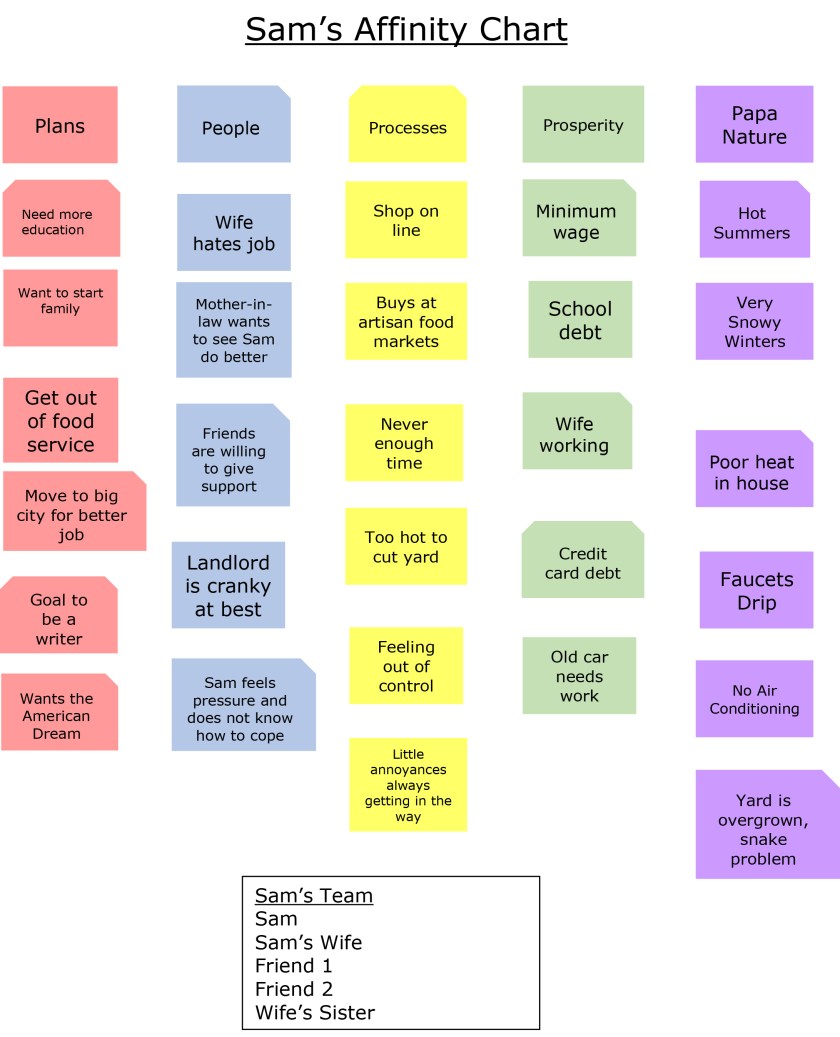
Sam's Affinity chart


Everybody had fun with the affinity game, and new ideas started to spring up. The infinity game (chart above) led to a Fish-bone diagram (below) which led to many other interests. I would tell you more now, except that may spoil some of the things to come. Therefore, we will start by taking a look at the affinity chart, and the Fish-bone diagram and that will start us on the way to helping to solve Sam’s problems.
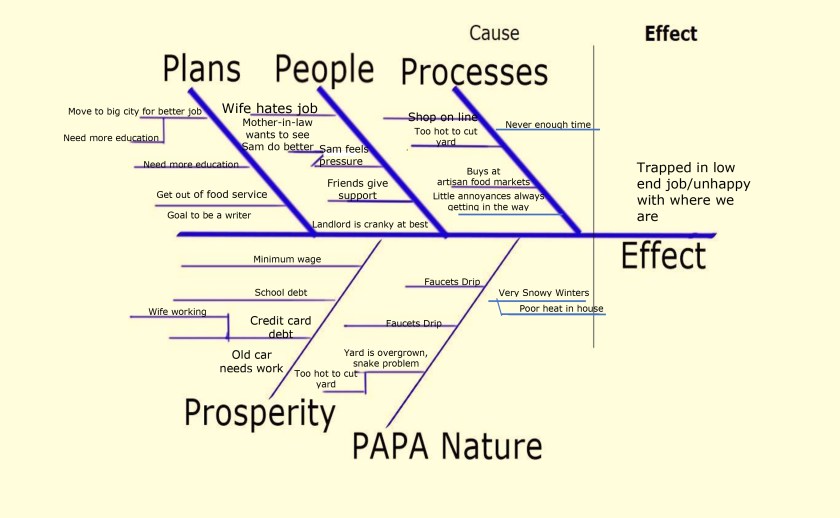
Sams Fishbone

Tomorrow we will press on and see where this leads.


On this day, we celebrate the Declaration of Independence

Hi, because today is a holiday, I wanted to pass along this holiday note for the fourth.  We continue our normal blogs tomorrow.

Long distance relationships almost never last.  Mine did not last, although we are still good friends.  The relationship between England and the American Colonies did not last, although Britain and the United States are the best of friends now.

On this day, we celebrate the Declaration of Independence. Actually, it was signed on the second of July.  With no mass communications and no copiers in 1776, it took a couple of days to write copies and to get the word out.

It makes me wonder.  If long distance communication were available at that time, would it have made a difference?  Money is the root of many breakups. Could, however, the economic problems, between England and the Colonies be settled amicably before they grew so large that the two entities had no choice except the War of Independence and the legal separation, which was akin to a divorce of peoples?

This sounds like an academic quandary to be debated, and yet, we are on the cusp of the exact same problems in the very near future.  The people of Earth are planning to colonize the Moon and Mars.

The distance to the Moon and especially the distance to Mars will test the ability of communications. Not that communications are as slow as the 1700’s, there is a lag time that will start out as a nuisance.

Just as with England and the American Colonies. When the colonists of the Moon and Mars mine their ores, their focus will be on their work and not as much on the massive cost the Earth spent to get them to their colonies and provide for them as they began.  The Earth, like England, may be in a rush to reclaim the money spent to set up the colonists.

Special care needs to be planned for the missions to ensure a premium is placed on collaboration and communication.  These must be real communication and collaboration processes, not just buzz words.

Understanding what lead up to the Declaration of Independence 241 years ago is vital to future plans of colonization.  George Santayana reminded us why, when he said, “Those who cannot remember their past are condemned to repeat it.” (Wikipedia, last updated, 2/13/2006)

A special thank you to Paul Nielsen for his discussions and suggestions on this blog.  Thank you.

The Affinity Game

Howdy!

I am very proud of all my sons.  They have each graduated college and are doing fantastic in their fields of endeavor. Especially my son who is a Ph.D. and a tenured college professor. I was amazed that he was published three times as an undergraduate. In all three times, the papers dealt with games. I knew I should’ve stayed in college. That is okay I am developing some new games that we can play.

I hope you were with us in our last session when we discussed and went through a scenario on solving a problem and overcoming a Band-Aid fix.

Every time you have a problem pop up, and is reoccurring, it is developing what we call a hidden factory within your normal life. The hidden factory is something you don’t normally plan on, and yet it happens. Hidden factories steal time and money.  Usually both.

Sometimes we have so many small problems that keep vying for our attention, we don’t know which one to fix first. Sometimes we end up focusing on a small set of problems that are annoyances while missing either more costly problems or items that may be safety issues.

To help keep the larger problems from creeping up on us from behind, it is good to keep an eye on them, and even rank order what you need to fix first and what may be able to wait a little while until you have a better time or better money. To do this, you can play a game with an affinity chart. You can get the whole family, significant others, and/or friends involved in this. I like to make a party out of the affinity game. Have some soda and popcorn or some coffee and cake, or just good friendship. The game requires some post-it notes, a place you can put the Post-it notes, and something to write on them with.

This is a problem hunting game. Think of it this way, what items are giving me grief, taking my time, or taking my money? If I want to save time and money, I need to identify them and start to fix them. If there is something that would cause harm, or flood the house, I want to fix that one first. If I have a screen that is loose, I do want to fix that, I just may need to fix something else first.

In the affinity game,  use five headings.  The headings are People, who are those who are affected, family and/or friends. Plans, they are the overall goals, not just the problems. Processes, how we do things such as pay bills, buy groceries, etc.. Prosperity, the paycheck and other resources we use. Lastly, Papa Nature, the environmental concerns such as living in tornado alley or near a flood plain. You want to write these five areas on separate Post-it notes and place them on a whiteboard, a wall that won’t be marred, or some other flat surface where you can put plenty of other Post-its below each one.

To start out, go around the room, and each person puts one Post-it note under a heading with one item they think could be done better. Just list the item. Don’t give ideas for fixes or long written descriptions now. It is probably good to have somebody act as the facilitator for this. You could even spark interest by having the child or teenager be the facilitator. The facilitator also places post-its on the chart when it is his or her turn.

If more than one person hands in a Post-it note with the same item or nearly the same item on it, that is okay. Put those Post-it notes on top of each other. The fact that there are multiple Post-it notes shows a deeper concern in that area.

You can limit the affinity game to an hour, or you can keep on going until no one else has anything that they can think of to put on a Post-it. The more Post-its, the better because you’re getting ideas out there. And every idea is of value to the person who had it. Every person is also valuable to the family or team as a whole.

When the game is done, everybody should thank each other and tell each other that everyone is important to the family or the team. The nice thing is now you have information.

You have gathered data. It is believed, and talked of, and is yet to be proven. It is, however, valuable data because it is a start.

Next time we will take what has been learned here with the affinity diagram and learn how to use it in our next step.

Thank you for being with us.

The Right Tool Always Works Best

Do Not Try This at Home.  Have you ever tried to put a nail into a board by pushing it in with your fingers? Or maybe just banging it in with your fist? It could get painful. Have you ever tried to drill a hole for dowel with your fingernail or really dig into it with the thumbnail? DO NOT try any of these methods. There are better ways. Just a few minor manual tools such as a claw hammer and a hand drill would not only be safer and less dangerous, they would get the job done a whole what faster.

Tools are a wonderful thing. Tools are there to assist you to do a job that you want to get done. The right tool always works best when used for the right job. There are manual tools and power tools, a screwdriver will open a can of paint, but it can also slip and cut your hand. Believe it or not, most stores will give you for free a little key to open your paint can easily and safely.

You don’t have to have fancy power tools all the time. A cordless drill always helps, or the circular saw if you cut a lot of wood. Yet, there is nothing more fun to watch, nor anything more enjoyable than seeing the happiness in a kid as he uses his first manual tool set to build his first birdhouse or his first sailboat. Although inexperienced, the young one is thrilled with his first tools.

Tools aren’t limited to carpentry. Mechanics have many types of tools to help every day. And, we have other great tools at our disposal.  I had a birthday yesterday which helped to remind me I am not the youngest rooster in the barnyard. I do not mind the slow walk toward senior citizenship, it does bother me when I feel I am acting the senior citizen stereotype.

The nice thing is, there is help using the right tools to keep me on point. Just like the carpentry tools, these tools can be very simple and manual or very complex and powerful. We need to play with them to understand which ones are right for each of us. Whatever we use, these tools should not cost us an arm and a leg. It doesn’t matter how much we would like to turn in that arm or leg for new one.

The last three weeks, we looked at goal setting and building a map to where we wanted to go in life. This week started out with a wonderful tool called a decision tree which helps you to record how you work on a problem or solution. The work can be done on a piece of paper, a notebook, on a tablet or a computer.

The decision tree doesn’t have to be fancy to be effective.  Simple is just as good. I’m sure there are people designing software to make the tree quite complex.

The simple fact, the decision tree is a tool. It won’t do everything for you, but it will help you with the task you’re trying to complete. I would like to show you some other tools you use to accomplish what you want to do, help keep your tasks straight, help show  what should be done first, help determine what is value-added, and what is not value-added. And, a few other things

If the tools start to look like something from process improvement class, you are probably right. Are we going to force everybody into groups to talk for hours each week and drag out long decisions over storyboards and printed slide presentations?  Oh, heavens no! We are going to simply take some tools and mold them, so they work for the needs of each of us. This means you’ll get to customize your tools to better do what you want to be done. In the end, the tools will help you to be on time, pay the bills when due, keep in touch with others, make better decisions, and save some money by spending it more wisely.

Bottom line, I’m not writing about the tools, is much as I’m writing about what you can do with them.

Have a great day and tomorrow will start with our next tool.

Thanks for being with us.


Recap

I hope all is well.

We’ve gone over quite a bit in the last few weeks, and I thought today would be good to take a moment and recap a little bit and help anybody who’s coming in late to go back and re-look at the blogs that were posted over the last few weeks.

We started out back on 5 June looking at the fact that perfection is different for every person were all individuals and what we look for and what we desire is going to be something different than the person standing next to us. And that is good. It is those differences which helped propel the world forward and make life interesting for us.

Next post, we talked about taking a stand and making a difference. This was done in a post, “You are way too good and way and too needed.”  In this blog post, we called everybody to make that stand, to get out and see what was possible.

We talked about comfort zones in a blog post and why it’s so hard to get out of a comfort zone, no matter how much you hate it. And in the post after, we talked about finding your goal. Each person has their own goals, their own desires, and their own needs. I encourage each of us to find the ones we need and desire and are truly our own.

We considered how to talk to people. And how to hold attention. The best oral exchange of ideas, training, and sharing of ideas comes with a soft and caring voice. These exchanges rarely take place with emotional yelling or screaming.

The next blog talked about how to plan for your goals, and why that is so important. After all, you cannot get what you don’t aim at. That same day I republished my website and let everybody know. It doesn’t have anything to do with the course we are going through, it was just a goal of mine. And, you are welcome to enjoy www.readingsticks.space anytime you wish.

The next blog gave you ideas on finding supporters and mentors. No one seems to get anywhere in a vacuum. For within the vacuum, no one else knows what is happening. Mentors and supporters play a very positive and very needed role within the lives of others. It’s a good thing to have, mentors, and a good thing to be, a mentor or supporter.

Our next post highlighted the fact that computers are taking over many jobs. Many reports say as many as 38% of the jobs will be done by computers within the next 15 years. Although I’m still have not received my flying car and jet pack, if you would like to know more of what I think will happen, please check out my book “Thriving as Humans in a Computer Run World,” which is on Amazon right now.

Earlier this week, I asked you to consider your goals. And, we talked about the fact that having a goal gave you something to work towards that you wanted. We also talked about the need to research the goals, and sometimes change those goals, due to life events.

Then we spent two days mapping those goals. Actually drawing the road to where the we are planning to go to reach each of the milestones is important. The milestone, in turn, help us to reach our goals.

I hope you’ve enjoyed this so far. I would really like you to send me a comment as to what you like, and what you would like to see more of.

Next week we will continue the fun. And I look forward to hearing from you.

Thank you for walking this goal path with me.


Mapping Your Goals Day Two

Did you get a chance to think about your map last night?  Maybe start laying out the roads that you might go on? We are talking about this for a second day, yet it will probably take longer to complete your map. Some maps stay in a state of flux. The changes happened not because the goals themselves are constantly changing, rather new milestones and side trips along the way.

I added mile markers.  You cannot expect to always get to a mile marker on time.  It is good, though, to know about where you are.  Mile marker one is the fact that you started. I did not put a mile marker for your start, I did add a hiker, and that is you along the trail. The big circle at the beginning allows you space to put in who and what is going with you on your journey.

Mile marker number two is gaining your knowledge. Whether it is a certificate, a degree, a seminar, or something else, knowledge is the thing that we were not necessarily born with, yet pick up along the way.

Milestone number three shows your climbing the trail, and this milestone reminds you to stop and smell the flowers. Enjoy the good things around you. There is a difference between taking a little time or enjoying something and letting it deter you from your goal. Being able to enjoy ourselves is the reason that we are going towards that goal.

Milestone number four is the family if you’re younger, you may be developing a family along the way. If you’re a little older like me, you may be bringing your family with you. Your family is very important to you. Nobody makes a trip like this alone.

Milestone number five climbing the corporate ladder. Whether you are in a corporation, entrepreneurship, profession, or in some other structure, a ladder to climb will always be there somewhere. You need to gain your professional reputation. And you will need to learn as you grow. And the more you assist others, the more you are helped in return. My father-in-law was a senior executive with IBM, and I remember him telling me to be nice to the everyone you meet on the way up, those of the same folks you’ll see on the way back down.

Milestone number six is a decision. I do not know why I only know that everybody encounters decisions. In this version of the decision, having done well to this point, do you want to press on towards your goal? Or, want to look at pushing higher in the big city and doing more and earning more? Or is it time to go to the beach and enjoy the sunset? Yesterday I told you that changes do happen sometimes caused by life events and sometimes caused by changes in desires. Any choice you make here is right as long as it’s your choice. You’re not at your goal yet. You can get to your goal by just continuing to climb towards it. And yes there is hard work on the way.

Milestone number seven was my goal. A nice compound and a boat to go sailing with and a lot of fun. Your goal will be different, and it is more important because it’s your goal.

I have a secret all share with you. The goal is great, yet it never compares to the fun you have and the people you work with along the way. Those are where the great memories are made. It is never the destination. It is always the journey.

Thank you for working with me on this. Tomorrow we will look at the next neat thing along the way. Have a great day.


Defining the Goal

Now it’s time for us to be able to understand what our goal looks like. I hope you’ve been writing everything down and keeping track of who goes with you to your goal, what goes with you to your goal and something new for you to keep an eye on what and who do you pick up along the way to your goal.

The first step in knowing where you want to go is to know where you are right now.  This is where the lists and notes you have been taking throughout this book come in handy.

You can be different and live in a cave and wear an old monk’s robe and not do anything. You could also be a lottery winner. How often does that happen?  Back to reality?  OK.

The first thing we need to do is help you find out where you want to be, and then we want to work on how to get you there.

Remember, it does not matter how outrageous or costly or in need of education or any other impediment might stand in your way. This is just establishing what you would really like to do. The mere fact of writing it down sets you on the journey. It does not guarantee you anything. It is just a start.

If you are not sure, you can find a short quiz to take online.  There are many free on the internet.  The one I like, and which is free and given to you by the Department of Labor and the Department of Education is called my next move. The web link to it www.mynextmove.org.

You can also check at local colleges, and other organizations in your area to see if the Myers-Briggs test is given anywhere. The Myers-Briggs might be given free by some organizations, and other organizations may want to charge a small fee to administer it. Look around and find your best bargain. Or, look for a free test online. Just be careful, some websites will give you the test and then want you to pay for results. I wouldn’t do that.

If you are not sure what you want to do, and you take some of these tests, they should point you in some pretty good directions. If you take the test, and you still are not sure of what you want to do, don’t worry.  Some of my best friends are over 39, and still trying to figure out what they want to do in life. And, they’re good people, and I know that someday they will figure that out. Do the best you can with where you are and what you have.

One thing I should warn you about so that it doesn’t happen you as it has to so many people. Some people (and I have done this before) don’t figure out what they really want to do. They want to do everything.  Rather than being happy with one goal and one direction, some people are always running around looking. Every time they hear something new from somebody, they are off trying it.

It’s interesting to see new ways of doing things, and it’s fun. It is also, sometimes, very costly and leaves people empty. Why is that? Because they’re looking in the wrong direction for the answer.  Nobody knows you better than you do.  Most of what’s going to motivate you, and make you work do not live in some webinar somewhere, it lives inside of you.

You are the person in control.  You must live with whatever your decision brings. Paying others to tell you about ideas or having others do everything for you is not very helpful.

It is good to take classes and learn things. When you pick something you want to be, do your research and make sure this is the path and the goal you truly want. A little research up front may save you from some real future mistakes.

I know this looks like a lot to do today.  Look into the ideas and consider your options.  Tomorrow we will start to draw the map to the goal.

Have a great day.


The Computers Aren’t Coming, They Are Here

We have something new that you really need to consider when you’re looking at goals. That new item is an old friend called technology. We all love technology. Technology gives us wash and wear clothes that we can just throw in the dryer pull out and put on a hanger. Technology gives us everything from three-minute popcorn to being  able to watch all shows and movies for next to nothing without even having to leave the house. Computers allow us to talk to anyone in the world. To run our own business., and to do many other marvelous things such as the ability to look up anything we need to know at any time 24/7and be able to get a credible response.

Technology has become so good at what it does that it is now taking over jobs. We’ve all heard the talk about someday and some way. Well someday and some way, have arrived. There are 21 different jobs which automatons now do. An article in the Los Angeles times reports that in the next 15 years 38% of jobs can be run by automatons.

30 years out it looks as though those numbers more than double.

Take a look at the goals that you have set for yourself. Does anything include employment that may be considered dull and boring, dirty or filthy, dangerous or life-threatening? You may want to rethink careers that fall into these categories. The reason is those are the areas that are best suited for automatons to work in.

Humans will never be totally pushed out of the picture.  Yet the positions for humans who want careers done in mass by automatons will go to those who are outliers.  That is to say, those who lead and innovate in that career field.  You can be one of those if you are willing to do what it takes.

Tomorrow we will help you to look at your completed goal.

Have a great day.

Supporters and Mentors

Hi, how are you?

Did you spend some time researching what you would like to do in life?

Remember, it’s researching that will save you money and time. You don’t want to invest heavily in something and then after for six years of schooling and apprenticeship find out that you really don’t like to do the job that you just learned. Believe it or not, this happens to many people.

Part of your research should be finding people who are willing to talk with you and give you some encouragement towards your goals. Trying to improve, can feel like trying to move mountains.  Having people who are willing to help mentor you is a great benefit to your work and your morale.  Find your supporters and invite them to be on your team as mentors, collaborators, partners or friends.

Most people are proud of what they do, and it is easy to get people who will talk with you for 20 minutes. It is easier if they can feel you are not going to put them on the spot, ask for a job, or take too much time from them. Below we have some do’s and dont’s and some ideas on finding and setting up mentors.

Ask those who you admire and look up to in your profession if it would be all right for you to call them some time with a question.  People who rise up in their business are frequently proud of what they do.  Professionals like to talk with others about what they do and how it helps others.  Most of them usually make time (20 minutes or so) to talk to someone or answer a few questions. 

As the person seeking the advice of a professional or mentor, it is important you not waste their time.  When you talk with them, have questions ready to go.  Pay attention to them.  Ask follow-up questions; however, do not argue with them.  Whatever you do, do not ask a professional who is giving you a little of their time for a job.  Asking for a job would put them in an uncomfortable position and cause the interview to end prematurely.  If they ask you, then you can give them a copy of your resume.

An Exercise in Collaboration

Call ten supportive friends and ten people whom you respect and who work in the same profession you want to work in.  Tell the friends what you are doing and ask if they could be part of your support group. Ask if you could speak to them, on occasion, about what you are doing. 

Ask the professionals if you could ask them a question now and then, and count them as a mentor.  Keep track of who says yes.  This looks hard, and you will be surprised how easy this exercise ends up being.

What does a new person to an industry want to know what they want to become?  Each of us will have different questions.  Some of these issues may be:

  1. What does the professional I want to become actually do?
  2. What are the pros and cons of the profession I am going into?
  3. What does the job I want to go to pay?
  4. What are the milestones in the business that I should look for to tell me I am doing well?
  5. Who are the industry leaders in my profession and what sets them apart?
  6. How much do the industry leaders make?
  7. What is an industry leader’s lifestyle in my desired profession like?

Many people will give you 20 minutes to ask a few questions about what they do and how their business actually works.  If you ask to talk to anyone, they will probably say yes.  When you meet with them, you want to ask real and specific questions and honor the time limit agreed to unless they wish to spend more time with you

Here are some Dos and Don’ts.

Do

  1. Have questions ready.
    1. It is hard to think of the right questions on the spot.
  2. Be polite, the person you are talking to is freely giving their time.
  3. If you have questions based on what the professional says go ahead and ask them.
  4. Be on time.
  5. Dress professionally.

Do Not

  1. Ask questions that you can find out from their (or their companies) Website.
    1. Do your research.
  2. Ask them for a job.
    1. Asking for a job often puts them on the spot and ends the interview.
  3. Waste their time.
  4. Dress or act unprofessional.

Next time, we will evaluate the desired positions in relation to new technology that is taking over many positions. 

Have a wonderful day.


Congratulations – It’s a Website

Here at ReadingSticks, we have exciting news today.

Today we have launched our newly revised website ReadingSticks.space.

This allows you us to bring everyone the ability to find and procure our courses, books, charts, and other help.

On our new site, you may contact us either by email, on our scheduling and contact page or you will be able to schedule a phone call with us. The first phone call which can last up to 30 minutes is free.

This offers us the ability to communicate and collaborate with anyone who needs help, or individualized service for them or for their companies.

Although this site was brought online today, you will see many additions installed and various changes in the next few weeks as we calibrate the site to the needs of our audience.

Please enjoy viewing this site at http://www.readingsticks.space

Please leave us a comment telling us what you like about the site and/or what you would like us to add or take away.

Thanks,

Mike Balof, Director Reading Sticks, LLC