Ever Play 20 Questions?

When you were a kid did you ever play 20 questions? It was a fun game to help pass the time. It basically worked by everyone agreeing on a topic (person, thing, activity, etc.) One person would pick something based on the topic. Everyone else playing the game would ask the person questions for a yes or no answer. A few years ago, an electronic game of the same name, and played the same way was a hit in the marketplace as a holiday gift.

Today, I promised you forests of decision trees, and here I am talking about games. The neat thing is, the 20 questions game is the same decision matrix which is used in the decision tree. You ask a series of questions for which there can only be a yes or no answer. You do need to verify the answers as you go. This, though, is often the easiest, and smartest way to discover root cause, or help you decide on a course of action.

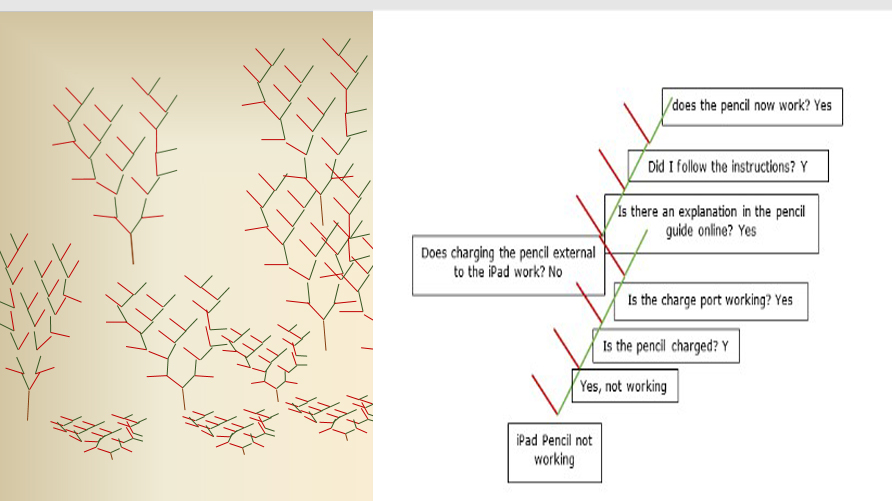
If you look at the trees, each junction has two branches. A red branch which we will call the ‘No’ branch, and, a green branch which we will call the ‘Yes’ branch. It is always good to draw your decision tree as you go.

You can do this in your notebook, on a whiteboard, on your computer, on a tablet, or on your smartphone, depending on what type of software you have loaded. I like to put mine either in my tablet or in my notebook so I can refer to the decision tree later.

Remember, a no is not always the end of a line of questioning. You can explore a no route, although it is often easier and more correct to follow the yes trail. By doing so, you stay on a positive path. If you do this, ask the questions in a way that yes leads you on, and no helps you to eliminate something. In that case, and it is the case I recommend, your tree will look like the one on the right above.

Let’s run a practice decision tree just to test one out. This is something that happened to me last night, and although I did not draw the decision tree at the time, these are the steps I took.

Last night the pencil to my iPad did not work, I was frustrated. It cost hundred dollars, and I was in no mood, nor prepared to buy another one. So this means I had to figure out why and make the pencil work again. This decision tree will be the one on the right, not the forest on the left.

  1. Is the pencil not working properly? Yes, not working
  2. Is the pencil charged? Yes (I charged the pencil for 15 minutes to ensure it was charged.)
  3. Is the charge port working? Yes (I could charge the iPad)
  4. Does charging the pencil external to the iPad work? No (tried it, this means it’s not the charging port)
  5. Is there an explanation in the pencil guide online? Yes (I followed the instructions)
  6. Does the pencil now work? Yes

I learned new things last night. I also learned not to be the cliché of the guy who reads the instructions only as the last step. Next time, I will move reading the instructions further up the list.

Whether I do it consciously or subconsciously, I like the decision trees.


Supporters and Mentors

Hi, how are you?

Did you spend some time researching what you would like to do in life?

Remember, it’s researching that will save you money and time. You don’t want to invest heavily in something and then after for six years of schooling and apprenticeship find out that you really don’t like to do the job that you just learned. Believe it or not, this happens to many people.

Part of your research should be finding people who are willing to talk with you and give you some encouragement towards your goals. Trying to improve, can feel like trying to move mountains.  Having people who are willing to help mentor you is a great benefit to your work and your morale.  Find your supporters and invite them to be on your team as mentors, collaborators, partners or friends.

Most people are proud of what they do, and it is easy to get people who will talk with you for 20 minutes. It is easier if they can feel you are not going to put them on the spot, ask for a job, or take too much time from them. Below we have some do’s and dont’s and some ideas on finding and setting up mentors.

Ask those who you admire and look up to in your profession if it would be all right for you to call them some time with a question.  People who rise up in their business are frequently proud of what they do.  Professionals like to talk with others about what they do and how it helps others.  Most of them usually make time (20 minutes or so) to talk to someone or answer a few questions. 

As the person seeking the advice of a professional or mentor, it is important you not waste their time.  When you talk with them, have questions ready to go.  Pay attention to them.  Ask follow-up questions; however, do not argue with them.  Whatever you do, do not ask a professional who is giving you a little of their time for a job.  Asking for a job would put them in an uncomfortable position and cause the interview to end prematurely.  If they ask you, then you can give them a copy of your resume.

An Exercise in Collaboration

Call ten supportive friends and ten people whom you respect and who work in the same profession you want to work in.  Tell the friends what you are doing and ask if they could be part of your support group. Ask if you could speak to them, on occasion, about what you are doing. 

Ask the professionals if you could ask them a question now and then, and count them as a mentor.  Keep track of who says yes.  This looks hard, and you will be surprised how easy this exercise ends up being.

What does a new person to an industry want to know what they want to become?  Each of us will have different questions.  Some of these issues may be:

  1. What does the professional I want to become actually do?
  2. What are the pros and cons of the profession I am going into?
  3. What does the job I want to go to pay?
  4. What are the milestones in the business that I should look for to tell me I am doing well?
  5. Who are the industry leaders in my profession and what sets them apart?
  6. How much do the industry leaders make?
  7. What is an industry leader’s lifestyle in my desired profession like?

Many people will give you 20 minutes to ask a few questions about what they do and how their business actually works.  If you ask to talk to anyone, they will probably say yes.  When you meet with them, you want to ask real and specific questions and honor the time limit agreed to unless they wish to spend more time with you

Here are some Dos and Don’ts.

Do

  1. Have questions ready.
    1. It is hard to think of the right questions on the spot.
  2. Be polite, the person you are talking to is freely giving their time.
  3. If you have questions based on what the professional says go ahead and ask them.
  4. Be on time.
  5. Dress professionally.

Do Not

  1. Ask questions that you can find out from their (or their companies) Website.
    1. Do your research.
  2. Ask them for a job.
    1. Asking for a job often puts them on the spot and ends the interview.
  3. Waste their time.
  4. Dress or act unprofessional.

Next time, we will evaluate the desired positions in relation to new technology that is taking over many positions. 

Have a wonderful day.


Not Planning Forsakes Goals


When you make your plans and set up your timelines, start with who and what is most important to you. Then you have to think and make plans for what it will take to sustain those people and things which are most important to you.

Make your plans synchronize to the movement of life. Those plans must meld with the time, the seasons, the phases of our lives, and our trek towards our goals and objectives. And while doing this, understanding that no matter how perfectly we develop these plans and goals, nothing is guaranteed. At the same time understanding that not planning forsakes those goals to the whims and desires of everyone and everything else. Planning and goal setting is essential.

Last week the blog spoke on gathering your lists and data and knowing where you were. This week we will look at identifying where we want to be how we want to get there and what and even more important who we take with us along the way.

The first question is, “What I want to be when I grow up?” If you’re in high school, this is a very good question. If you are in college, this is an excellent question. If you’re in your mid-20s and tired of service level jobs, this is a most needed question. In your 40s this is a mandatory question and believe it or not between 55 and 65 this is a vital question. These questions at each step of our life help to hone and know where we are and where we want to be. If you are not sure of your goals, how will you know when you get there?

For today, please think about what you would like to do in the future. At this point don’t worry about money, education or other items. Think about what you like, what you think you would enjoy doing, and how that supports not only you but those people and things most important to you, and write it down.

Tomorrow we will start more exercises and have a lot more fun. And hopefully, I will have good news about a reconditioned website

Talk as Though You’re Saying Nice Things

It’s interesting that we can be the most knowledgeable on the subject. We can be the most caring on the subject. We have desiring compassion and understanding, and we want to act on something. Yet, without good communication and collaboration, we often fail.

Often, we failed because we get too eager and try to do things too fast and in that effort, we end up putting others off rather than bringing them into collaboration.

We are humans. Humans run on emotions. Yes, humans do run on facts, yet often those facts are clouded by emotional and often irrational fears. When dealing with others, a slow and steady approach is better than rushing the other person. The idea, you don’t want to scare them off.

There are ways to talk to people, and there are ways to talk to people. One the best things I learned in my 13 years as an instructor in the classroom is that it is not what you say to people, rather it is how you talk to them. I’m almost embarrassed to tell the way it works.

The trick to having a good tone in the classroom, in the boardroom, on the factory floor, or at the coffee shop, is to speak kindly. That is,  speak in such a way that your puppy dog would stop and listen to you if he or she heard the talk.  The dog would not understand the meaning, just the pleasant tone.

If you can talk in such a way that your dog will stop and listen to you, then people will also stop and listen to you. It is not what you are saying. It is the way you are sending the information. I often practiced my courses with my dog in attendance, and she paid very good attention. I am glad to hear it was not because of the tuna fish sandwich I held in my hand.

The trick is to talk soft, and whatever you’re saying, talk as though you’re saying nice things. If you do this and do not get pushy, people will listen to you.  They listen because they hear empathy.

Another thing to think of is not to make my favorite error. Rush to judgment. It turns out I’m a guy. And guys like to fix things. I’d like to blame it on John Wayne. Unfortunately, I think this goes all the way back to the beginning of mankind. The trick is to stand back and listen, and this is true for both men and women. Listen, have a good understanding, understand the main characters in any situation and what is going on, and then when asked, have a polite recommendation or to.

Now even though the guy thing (above) is something I’ve been able to practice for many years, I recommend listening and learning and then suggesting or helping to act. It is hard, it is frustrating, and it is very necessary. No one will see the situation the same way you will. Because they are using different eyes different knowledge different brains and a different position within any situation.

This is something to think of and something to consider.

I am proud to announce that we have redesigned the http://www.readingsticks.space website. We are putting the final touches on to the website now. You may see it on Wednesday as we perform live testing. And, depending on how the testing goes we will be live, and running either Wednesday or Thursday.

If you’re interested in what I work with and talk about, please come and take a look at the website there are many interesting things.I think you’d like it.

Have a great day.


You are way too good and way too needed

Yesterday, we thought on perfection. Do you view the world in black-and-white? Do you view the world as infinite shades of gray? Or do you live in the Technicolor world, where all dynamics, shades, colors, and opinions are viable depending on the circumstances?

By the way, I should tell you, answers are neither right or wrong here. There are the answers of each individual, who has to decide those are answers which are right or wrong for them.

I am not a philosophy major.  I am an education major with extensive education in corporate training, process improvement, and quality.

I ask these questions to have people think.

The reason I like to have people think is for one very clear fact.

I like to sit in my basement either in the easy chair or laying on the couch, watching my favorite TV shows or listening to the radio, or reading a good book. It is not the only thing I do. I take classes, I am at the library every other week, I have my volunteered and other actions. And I write, develop books, and develop courses which often tie in with the books, and develop charts for measurement and process improvement.

I like to do all this. And it keeps me busy. Yet I find that is because I get up off the chair or the couch in my basement turn off the technology and go out to communicate and collaborate with others.

The sad fact is if we sit in our basement or the backyard or the TV room and wait for somebody to come and help us, show us something better, or improve our lives for us, the dust would grow, and we will be long gone before anybody shows up. And those who do will mainly be looking for the source of the smells, and to collect the bones.

You are way too good and way too needed for such a destiny. Now is the time for you to stand and make a difference in your life and the lives of others.

Think about how you would like to learn or help and what you could do.  We will talk again tomorrow.

In the Eye of the Beholder

Everybody looks for perfection in the world. Yet finding perfection is tough. Perfection is found in the eye of the beholder. And therefore, it would be very hard to find two ideas of perfection which are the same. It reminds me of the speech from John F. Kennedy who said,” We do these things not because they are easy, we do these and other things because they are hard.”

People like the idea of heading towards perfection, because they look at perfection as black and white. Yet we do not live in a world which lends itself to black-and-white. Rather, the world looks upon all things in unlimited hues, shades, dynamic colors, and variables. What is perfection? That depends, and it is up to each one of us to decide what that meaning is for us.

This week, we will talk about perfection, versus reliability, versus sustainability, versus the ultimate, versus the needed.

I promised to keep this short. And I will.

For today, think of your ideas perfection, and how often you truly achieve it.

Some truths are universal, and they will never change.

One of the greatest things that we are going to have to learn soon and many smart people have already learned now is self-determination. It used to be that manufacturing, whether it be the wool industry, cotton textiles in America, early watchmaking or weapons manufacturing for settlers and the military required a vast army of workers both skilled and unskilled to build the quantities of finished products required. Automation, taking the place of workers, is not new. It was always sought by the best and the brightest of manufacturing.

The desire to build something cheaper, faster, or better has lived with us since the first product was made and sold. In our own colonial days, a rifle was sold by the purchaser piling up pelts next to the rifle stock, standing on end, until the gun and pelts were of equal height. One pile pelts for one rifle. The traders got smart fast and built rifles with longer barrels to maximize their profits.

The watch, which until around 1850 was too costly for most people, was affordable to almost everyone once the small gears and other parts became mass-produced. At the cost of only $13, rather than hundreds of dollars, the watch could then be purchased for military personnel, anyone needing to synchronize with railroads or children, mainly young men who were given the watch as a sign they were going to go places.

The fact is if somebody or something does a job better than you, faster than you, or smarter than you unless you are an outlier, you are not going to be able to take their job away from them. If you are an outlier, you’re probably not going to try to take that job away. Mainly because you know better.

You need to work on what you can do better. Better than others, better than computers, better than the present technology. If you can do this, you will probably be able to have jobs continuously. There are some catches involved.

If you want a job or series of jobs that you can count on you need to be an outlier. Outliers are not followers. Outliers are the people that others follow. Outliers do so because they are driven, not because someone is driving them. Outliers are like the young cadets at the Air Force Academy. Cadets are told the first day they came to the Academy, I’m sure most days after that, that they cannot go through the Academy for anybody else. Cadets must go through the Air Force Academy for themselves. If cadets don’t want to put up with the Academy’s rigid standards, and hard work, they will not be able to survive the riggers, just because somebody else wants them to. The same is true of outliers.

What do outliers do? Outliers figure out what they’re good at and what they like to do. Outliers learn everything they can about their profession and stay abreast of all current trends, usually setting those trends. Outliers never follow the crowd, they lead the crowd. Outliers never worry about being alone or lonely, because leaders rarely find themselves along, everyone else is looking to follow them.

Jobs will change. 

Times will change.

Needs will change.

People will change.

Some truths are universal, and they will never change.

And Yet I Wondered

As I drove to work today, I passed the high school. I noticed an old man, sitting on the corner by the high school, looking tired and dejected. Next to him was an old baby carriage which held all his earthly possessions piled high, covered over with blankets and tarps, all in a heap just about as tall as he was. It made me wonder.

I went on to work. After a while got up to stretch my legs. I walked out to the corner of the block. A crew of construction workers was digging up the street to replace the storm drains. The storm drains had not been replaced in over 100 years and were well in need of the updating. I watched the crew as they tore the road apart. They had the sidewalks close in two directions, denying people from my corner the chance to cross the street. And, they were dismantling the traffic light base. It made me wonder.

On the way back to my office, I said hello to a lady who was walking by. She stopped and talked with me for a few moments. We talked about the way the town used to look.

We talked about the pride of keeping up with infrastructure. We discussed the copper thefts of the decade ago when thieves stole cable to many of the streetlights. We talked about how copper was so valuable to someone that sprinkler systems and copper statues were stolen. Even air conditioner condensers were stolen from the backs of buildings because of the copper tubing inside. We agreed that we had a great new counsel who would help us to bring the city back to its greatness.

And yet, I wondered.

I wonder how we can build a better  infrastructure.  How we can balance the care of material things and the care of people. I wonder why people end up on the street pushing an old basket of worldly possessions, because I seem to see them more and more.

I also wonder why people would be so destitute, they would be willing to steal electrified copper wire, providing electricity to street lights which are a safety concern of all of us. I wonder why as we build our infrastructure renewing it and keeping the city current and beautiful, we still have those whose life is so difficult and are so far out of touch.

It is said the poor will be with us always. This is true. And yet, we must understand that society is caught in lockstep. The height of society can only go as high as the lowest member of society can allow. For society to climb a ladder and go higher, the least of society must be able to move up the ladder an equal distance. If this does not happen, growth stops, everyone stagnates, and entropy enters the mix as the society starts to crumble.

Today, I still wonder. What can we do as a society to elevate the poorest and lowest among us so that we may pave the way and climb higher? I also wonder if we do not take on the challenge to raise the least of society how will we ever climb higher. I also wonder as we start to crumble, what will the entropy look like.

Please add your ideas and thoughts to this blog.  Thank you for reading.


Are You At The Top of the List of People Who Do What You Do?

Well, are you?  Some people will tell you that no matter where you are on the list, there will always be somebody above you and always be somebody below you. I don’t think that this works out logically.

There are over 1 million people who work for franchised car dealerships in America. If we had a million names on the list and measured them on work performance, somebody or a group of somebodies would be number one on the list. In the same for the last place on the list. Somebody has to hold the last place also.

The real question is, ‘How important to you, is your place on the list?’

Are you driven by a Desire to be number one?  If number one took home $50 million dollars a year, and you only take home $40 million a year, so what?  What difference is $10 Million a year?  Does it put you in a category of higher wealth or status?  Is the drive to number one an ego trip?  Would you still be going after the number one spot if the rewards did not make up for the losses you would experience along the way?

As our world economy evolves, those who are positive outliers will be the ones to profit.  Outliers are a given.  Yet, I wonder why, for some, just being an outlier is not enough.  Some look at themselves as failures unless they can be the best.  Number One!

The thing to know is, in the rest of the list below first place, there are plenty of people looking to unseat the leader and take over.  Being ‘Number One’ is a very tenuous and temporary position.  The money is good, yet is it that much different.

Spending more time working with the family, helping relatives, planning a future with the kids, and enjoying a well-cared for house and life, these are true works with great rewards.

Is being ‘Number One’ in business a good feeling?  Sure.  Are there greater rewards and good feelings to be found in live?  You Bet.

Planning

Have you ever noticed how frustrating it gets when your plans don’t go the way you expect them to go?  Have you ever gotten frustrated to the point where you cannot figure out how you got to where you are, no idea of how to get back on track, and just want to quit and hide?

Don’t feel bad we all get that way. We look at others on an outing, on a Saturday afternoon, and they look so much in control. We had problems with the store being out of what we wanted to buy, the kids having problems and being fussy in the car, or pets who decide they want to play chase and tag with you and run out the gate just as everybody’s getting into the car.

What do we do about our plans going wrong?  We learn to laugh a little. We understand these things happen. And, not to get upset every time something doesn’t go the way we desire.

Now you’re starting to think, “How did the pros do it?”  As a retired Master Sergeant, I’m here to tell you, there is no corporation better planning than the US military.  And yet, everyone in the US military who has ever been part of building a plan can tell you one thing, plans will generally fall apart with the first enemy contact.

You think I’m kidding you. I assure you I am not. We all develop our plans.  We plan the best we can.  We work with all our prayers, talismans, and other rituals to ensure things go right. And yet, in the end, there is always something that goes awry.

The question becomes, “Why do we do all of the work if we know at some point it will fall apart?”  The answer is simple, knowing that things will generally fall apart, you plan anyway. In that planning, you are continuously looking for the what-ifs, the contingents, the “if this” happens I will “do that.”

I’m not saying that you’re going to get lucky, although sometimes luck is involved. I’m not saying that you will think of absolutely everything. It’s rare. What I’m saying is, the more you plan, and the more you look at the contingencies, the better you will understand.

In understanding, you will see strong spots and weak spots. Having a heads up on strong and weak areas will make your decisions during the execution of the plan much better.  The decisions and changes are now based on what you learned during your preparation. What I’d like to suggest is make the best plans possible.

Every time I plan I know the plan won’t run as predicted. I do not know exactly what will happen to change the plan. I do know what options are available, and I can make much better’s decisions.

Ever planned, and the preparations made changes and decisions easier to make?  If you would like to share something about how planning saved the day when plans went awry, Please, give us a response and tell us what happened.