Everybody loves to learn something new

Everybody loves to learn something new. It makes us feel good to know something new. Learning keeps us young in heart and soul. Although we love to learn, no one likes to be taught. There are several negatives which have a tie to being poorly taught. My goal is not to teach you. My goal is to help you learn.

As soon as you mention things such as TQM, 8 – D, Six Sigma, or any of the other quality and process improvement techniques, you automatically find yourself the only person standing in the room. Everyone else ran. Most hate these classes.

Everyone who was ever ordered to take a process improvement class has a right. And everyone who wasted time sitting through endless meetings trying to figure out something to change has a right. And, all those who put up with the corporate politics of leaders who would never let the change happen, has a right to hate the subject.

We are not going to do that here.

You are a smart person. And you are responsible. Everybody has different responsibilities. You may have a house or an apartment, a family and/or a pet, and bank accounts and credit cards which you maintain. You are pretty good at the things you regularly do. And you’re probably a whiz at some others. Don’t let anyone put you down.

Everybody has things that go well and things which tend to go off the rails from time to time. I’m here to show you a few ideas you can learn to do, which will keep the same thing from going off the rails every six weeks or so.

Ever have a small problem that interrupts the momentum of your morning? For me, about once every six weeks I can’t find my car keys. When I come back to look for them, I am accused of losing them for good, and we will never be able to drive the car again!

They usually have fallen out of my pants pocket. Or, were left in a jacket or pants which I had used the day before. On rare occasions when I’m carrying things in both hands they end up left stuck inside the front door knob overnight. Good thing I lock the screen door.

To this annoyance, I usually apply what’s known as a Band-Aid Fix. Something super fast, super cheap, and something allows for the annoyance to be ignored until the next time it happens. The bad thing about this type of a fix is that it guarantees whatever the annoyance is it will happen again, and probably sooner than later.

My Band-Aid Fix to this is to set out a bowl on a table or nightstand which I plan to put the contents of my pockets into nightly. How often does this actually happen? Usually, the first night I set the bowl out and occasionally the second. I’m not a bad person, I just get busy and forget. Therefore, it is only a Band-Aid cure and guaranteed to happen again at regular intervals.

Because I work for myself (I think that is called a vow of poverty,) I have time to look for the keys. If I had to be somewhere at a particular time, I could be in trouble. So what is a better thing that I could do to ensure I knew exactly where my keys are first thing in the morning?

Are we going to write a long and lengthy process and perform follow up on it every six months? Absolutely not! What’s the smart thing to do? Because it’s my wife and me, we could take a few minutes and think about it.

Some ideas could be as simple as having a key rack with hooks by the door, where I place my keys when I come home and take them when leaving. The key rack could be in plain sight so we could both keep an eye on whether or not we were using it.

Another option, we could hide keys outside the house because if the keys are hanging inside the house, sooner or later, we will end up locking ourselves out. Unfortunately, neither one of us are trusting enough souls to hide keys outside the house.

Another option might be to purchase a key finder. Amazon has a plethora of key finders that work with everything from a whistle to your smartphone. Cost is usually somewhere between $15, and $24.  There are more expensive and less expensive models.

So on a five-minute conversation with your significant other, (maybe 10 minutes,) you discuss the situation with someone and come up with three good ideas. Which is best? It’s not for me to say, it is whichever method is most foolproof for you. Usually, the best processes remove human intervention.

Just a side note, when I can’t find my smartphone, I use the house phone to call the smartphone, and then I walk around the house trying to hear it ring. Always great to have a backup.

Thank you for being with us today.  Until next time, we wish you well.
The Right Tool Always Works Best

Do Not Try This at Home.  Have you ever tried to put a nail into a board by pushing it in with your fingers? Or maybe just banging it in with your fist? It could get painful. Have you ever tried to drill a hole for dowel with your fingernail or really dig into it with the thumbnail? DO NOT try any of these methods. There are better ways. Just a few minor manual tools such as a claw hammer and a hand drill would not only be safer and less dangerous, they would get the job done a whole what faster.

Tools are a wonderful thing. Tools are there to assist you to do a job that you want to get done. The right tool always works best when used for the right job. There are manual tools and power tools, a screwdriver will open a can of paint, but it can also slip and cut your hand. Believe it or not, most stores will give you for free a little key to open your paint can easily and safely.

You don’t have to have fancy power tools all the time. A cordless drill always helps, or the circular saw if you cut a lot of wood. Yet, there is nothing more fun to watch, nor anything more enjoyable than seeing the happiness in a kid as he uses his first manual tool set to build his first birdhouse or his first sailboat. Although inexperienced, the young one is thrilled with his first tools.

Tools aren’t limited to carpentry. Mechanics have many types of tools to help every day. And, we have other great tools at our disposal.  I had a birthday yesterday which helped to remind me I am not the youngest rooster in the barnyard. I do not mind the slow walk toward senior citizenship, it does bother me when I feel I am acting the senior citizen stereotype.

The nice thing is, there is help using the right tools to keep me on point. Just like the carpentry tools, these tools can be very simple and manual or very complex and powerful. We need to play with them to understand which ones are right for each of us. Whatever we use, these tools should not cost us an arm and a leg. It doesn’t matter how much we would like to turn in that arm or leg for new one.

The last three weeks, we looked at goal setting and building a map to where we wanted to go in life. This week started out with a wonderful tool called a decision tree which helps you to record how you work on a problem or solution. The work can be done on a piece of paper, a notebook, on a tablet or a computer.

The decision tree doesn’t have to be fancy to be effective.  Simple is just as good. I’m sure there are people designing software to make the tree quite complex.

The simple fact, the decision tree is a tool. It won’t do everything for you, but it will help you with the task you’re trying to complete. I would like to show you some other tools you use to accomplish what you want to do, help keep your tasks straight, help show  what should be done first, help determine what is value-added, and what is not value-added. And, a few other things

If the tools start to look like something from process improvement class, you are probably right. Are we going to force everybody into groups to talk for hours each week and drag out long decisions over storyboards and printed slide presentations?  Oh, heavens no! We are going to simply take some tools and mold them, so they work for the needs of each of us. This means you’ll get to customize your tools to better do what you want to be done. In the end, the tools will help you to be on time, pay the bills when due, keep in touch with others, make better decisions, and save some money by spending it more wisely.

Bottom line, I’m not writing about the tools, is much as I’m writing about what you can do with them.

Have a great day and tomorrow will start with our next tool.

Thanks for being with us.


Ever Play 20 Questions?

When you were a kid did you ever play 20 questions? It was a fun game to help pass the time. It basically worked by everyone agreeing on a topic (person, thing, activity, etc.) One person would pick something based on the topic. Everyone else playing the game would ask the person questions for a yes or no answer. A few years ago, an electronic game of the same name, and played the same way was a hit in the marketplace as a holiday gift.

Today, I promised you forests of decision trees, and here I am talking about games. The neat thing is, the 20 questions game is the same decision matrix which is used in the decision tree. You ask a series of questions for which there can only be a yes or no answer. You do need to verify the answers as you go. This, though, is often the easiest, and smartest way to discover root cause, or help you decide on a course of action.

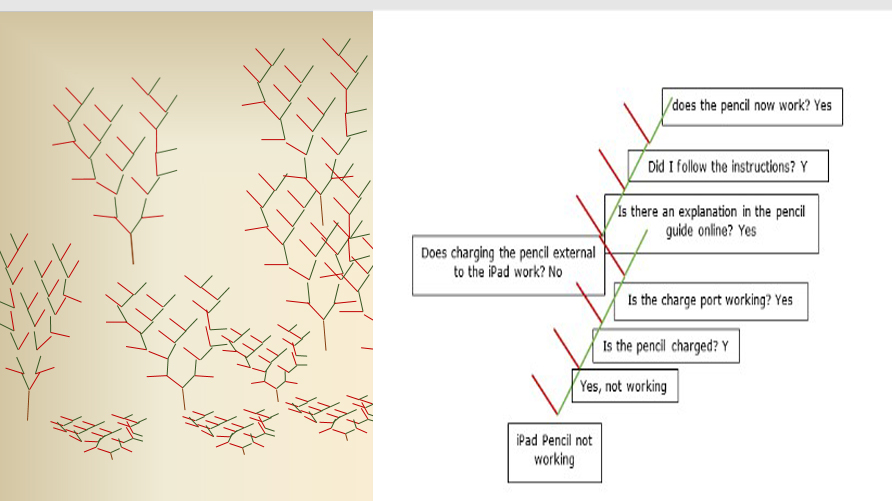
If you look at the trees, each junction has two branches. A red branch which we will call the ‘No’ branch, and, a green branch which we will call the ‘Yes’ branch. It is always good to draw your decision tree as you go.

You can do this in your notebook, on a whiteboard, on your computer, on a tablet, or on your smartphone, depending on what type of software you have loaded. I like to put mine either in my tablet or in my notebook so I can refer to the decision tree later.

Remember, a no is not always the end of a line of questioning. You can explore a no route, although it is often easier and more correct to follow the yes trail. By doing so, you stay on a positive path. If you do this, ask the questions in a way that yes leads you on, and no helps you to eliminate something. In that case, and it is the case I recommend, your tree will look like the one on the right above.

Let’s run a practice decision tree just to test one out. This is something that happened to me last night, and although I did not draw the decision tree at the time, these are the steps I took.

Last night the pencil to my iPad did not work, I was frustrated. It cost hundred dollars, and I was in no mood, nor prepared to buy another one. So this means I had to figure out why and make the pencil work again. This decision tree will be the one on the right, not the forest on the left.

  1. Is the pencil not working properly? Yes, not working
  2. Is the pencil charged? Yes (I charged the pencil for 15 minutes to ensure it was charged.)
  3. Is the charge port working? Yes (I could charge the iPad)
  4. Does charging the pencil external to the iPad work? No (tried it, this means it’s not the charging port)
  5. Is there an explanation in the pencil guide online? Yes (I followed the instructions)
  6. Does the pencil now work? Yes

I learned new things last night. I also learned not to be the cliché of the guy who reads the instructions only as the last step. Next time, I will move reading the instructions further up the list.

Whether I do it consciously or subconsciously, I like the decision trees.


Enjoy Each Moment for Where You Are

Morning. I hope everybody had a wonderful weekend.

Last week we mapped out a set of goals and milestones. Before we move on to our next round of ideas and workshops, I would like to give one more thought on reaching your goals. I wish to do this because many people look at the goal as the end. As you get to your goal, you’re going to find out, most likely, that the goal you have reached is merely the stepping stone to the next and even greater thing.

It seems that in nature and in life nothing is as simple as start-middle-end. For as each end is seen, new beginnings emerge. And, as new beginnings emerge they denote the end of something in the past.

And yet, not really, for when there are new beginnings. It is more flow from one thing to the next. The flow is natural and it is to be expected. I’m not telling you something as simple as go with the flow.  And, I know it’s a cliché to say each ending is a new beginning. I guess what I’m trying to say is everything is continuous. Therefore, enjoy each moment for where you are and who you are with.

Tomorrow, we are going to look at forestry, in a sense. We are going to grow a forest of decision trees. Decision trees are great, and they will help you in making some tough decisions, sometimes.

Please enjoy today, and we look forward to tomorrow’s discussion.

Thanks for being with us. 

Mapping Your Goals Day Two

Did you get a chance to think about your map last night?  Maybe start laying out the roads that you might go on? We are talking about this for a second day, yet it will probably take longer to complete your map. Some maps stay in a state of flux. The changes happened not because the goals themselves are constantly changing, rather new milestones and side trips along the way.

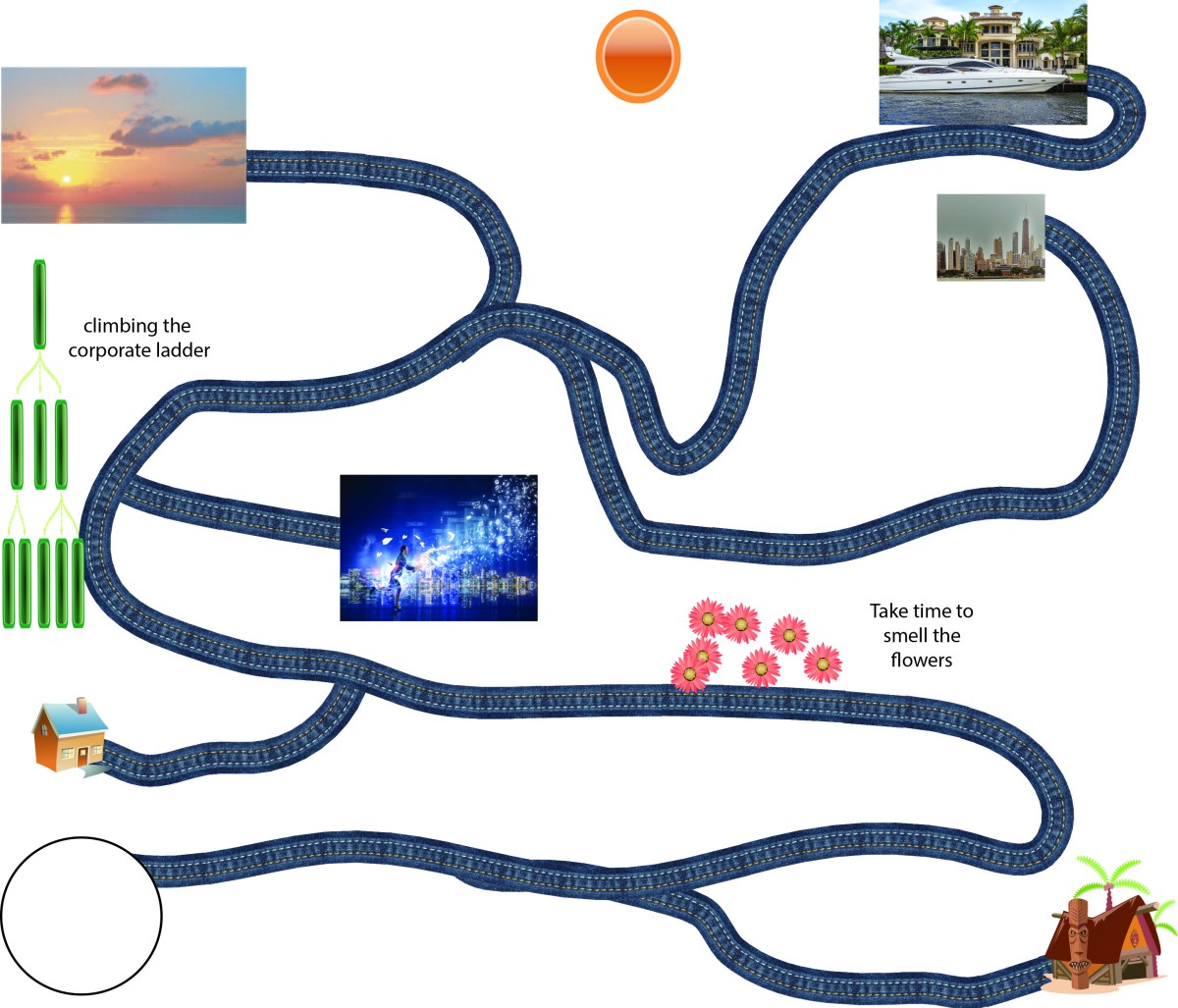
I added mile markers.  You cannot expect to always get to a mile marker on time.  It is good, though, to know about where you are.  Mile marker one is the fact that you started. I did not put a mile marker for your start, I did add a hiker, and that is you along the trail. The big circle at the beginning allows you space to put in who and what is going with you on your journey.

Mile marker number two is gaining your knowledge. Whether it is a certificate, a degree, a seminar, or something else, knowledge is the thing that we were not necessarily born with, yet pick up along the way.

Milestone number three shows your climbing the trail, and this milestone reminds you to stop and smell the flowers. Enjoy the good things around you. There is a difference between taking a little time or enjoying something and letting it deter you from your goal. Being able to enjoy ourselves is the reason that we are going towards that goal.

Milestone number four is the family if you’re younger, you may be developing a family along the way. If you’re a little older like me, you may be bringing your family with you. Your family is very important to you. Nobody makes a trip like this alone.

Milestone number five climbing the corporate ladder. Whether you are in a corporation, entrepreneurship, profession, or in some other structure, a ladder to climb will always be there somewhere. You need to gain your professional reputation. And you will need to learn as you grow. And the more you assist others, the more you are helped in return. My father-in-law was a senior executive with IBM, and I remember him telling me to be nice to the everyone you meet on the way up, those of the same folks you’ll see on the way back down.

Milestone number six is a decision. I do not know why I only know that everybody encounters decisions. In this version of the decision, having done well to this point, do you want to press on towards your goal? Or, want to look at pushing higher in the big city and doing more and earning more? Or is it time to go to the beach and enjoy the sunset? Yesterday I told you that changes do happen sometimes caused by life events and sometimes caused by changes in desires. Any choice you make here is right as long as it’s your choice. You’re not at your goal yet. You can get to your goal by just continuing to climb towards it. And yes there is hard work on the way.

Milestone number seven was my goal. A nice compound and a boat to go sailing with and a lot of fun. Your goal will be different, and it is more important because it’s your goal.

I have a secret all share with you. The goal is great, yet it never compares to the fun you have and the people you work with along the way. Those are where the great memories are made. It is never the destination. It is always the journey.

Thank you for working with me on this. Tomorrow we will look at the next neat thing along the way. Have a great day.


The Start of Mapping Your Goal

Well, looks like it’s time for us to start to map our destination. Above, you will see a goal map that I made up. I did this in Adobe. You can get the same results, though, within any number of drawing tools or utilizing the Microsoft software.  A fun way to do this that can involve everyone could be the old cut and paste on a large paper. Be sure to take a picture and put it on the computer.

Yours will not be exactly like mine, I just wanted to show you what the bare bones might look like for me.  Every map will be different because every person is different.

The beginning starts off with who and what is going to go with you on this journey. And that the opposite end, what that final destination looks like your goal. You can you view your goal from many various facets just as you can view a diamond. There are many facets to the goal, and not all of them can be seen in one of view.

The goal, cannot be gained overnight.  The great comedian, Allen King, once said that he had worked for eleven years to become an overnight success.  This is even true in making the map.  If you have followed along, You have thought, made lists, done research, and some planning. There will be milestones along the way.  If education is required, gaining it is a milestone.  If you have to climb the corporate ladder or learning your trade and earning street creds, those are milestones.

There are also plateaus where you may want to linger awhile or stay forever.  Remember This is your life, and as people grow and learn, goals will sometimes change.  You should not change your goals every day, and when you have an’ Epiphany of Life,’ change will sometimes follow.  And, that is all right.

Build your goal outline, and tomorrow we will continue with the map building.

It is hot here.  I hope you stay cool and dry.

Supporters and Mentors

Hi, how are you?

Did you spend some time researching what you would like to do in life?

Remember, it’s researching that will save you money and time. You don’t want to invest heavily in something and then after for six years of schooling and apprenticeship find out that you really don’t like to do the job that you just learned. Believe it or not, this happens to many people.

Part of your research should be finding people who are willing to talk with you and give you some encouragement towards your goals. Trying to improve, can feel like trying to move mountains.  Having people who are willing to help mentor you is a great benefit to your work and your morale.  Find your supporters and invite them to be on your team as mentors, collaborators, partners or friends.

Most people are proud of what they do, and it is easy to get people who will talk with you for 20 minutes. It is easier if they can feel you are not going to put them on the spot, ask for a job, or take too much time from them. Below we have some do’s and dont’s and some ideas on finding and setting up mentors.

Ask those who you admire and look up to in your profession if it would be all right for you to call them some time with a question.  People who rise up in their business are frequently proud of what they do.  Professionals like to talk with others about what they do and how it helps others.  Most of them usually make time (20 minutes or so) to talk to someone or answer a few questions. 

As the person seeking the advice of a professional or mentor, it is important you not waste their time.  When you talk with them, have questions ready to go.  Pay attention to them.  Ask follow-up questions; however, do not argue with them.  Whatever you do, do not ask a professional who is giving you a little of their time for a job.  Asking for a job would put them in an uncomfortable position and cause the interview to end prematurely.  If they ask you, then you can give them a copy of your resume.

An Exercise in Collaboration

Call ten supportive friends and ten people whom you respect and who work in the same profession you want to work in.  Tell the friends what you are doing and ask if they could be part of your support group. Ask if you could speak to them, on occasion, about what you are doing. 

Ask the professionals if you could ask them a question now and then, and count them as a mentor.  Keep track of who says yes.  This looks hard, and you will be surprised how easy this exercise ends up being.

What does a new person to an industry want to know what they want to become?  Each of us will have different questions.  Some of these issues may be:

  1. What does the professional I want to become actually do?
  2. What are the pros and cons of the profession I am going into?
  3. What does the job I want to go to pay?
  4. What are the milestones in the business that I should look for to tell me I am doing well?
  5. Who are the industry leaders in my profession and what sets them apart?
  6. How much do the industry leaders make?
  7. What is an industry leader’s lifestyle in my desired profession like?

Many people will give you 20 minutes to ask a few questions about what they do and how their business actually works.  If you ask to talk to anyone, they will probably say yes.  When you meet with them, you want to ask real and specific questions and honor the time limit agreed to unless they wish to spend more time with you

Here are some Dos and Don’ts.

Do

  1. Have questions ready.
    1. It is hard to think of the right questions on the spot.
  2. Be polite, the person you are talking to is freely giving their time.
  3. If you have questions based on what the professional says go ahead and ask them.
  4. Be on time.
  5. Dress professionally.

Do Not

  1. Ask questions that you can find out from their (or their companies) Website.
    1. Do your research.
  2. Ask them for a job.
    1. Asking for a job often puts them on the spot and ends the interview.
  3. Waste their time.
  4. Dress or act unprofessional.

Next time, we will evaluate the desired positions in relation to new technology that is taking over many positions. 

Have a wonderful day.


Congratulations – It’s a Website

Here at ReadingSticks, we have exciting news today.

Today we have launched our newly revised website ReadingSticks.space.

This allows you us to bring everyone the ability to find and procure our courses, books, charts, and other help.

On our new site, you may contact us either by email, on our scheduling and contact page or you will be able to schedule a phone call with us. The first phone call which can last up to 30 minutes is free.

This offers us the ability to communicate and collaborate with anyone who needs help, or individualized service for them or for their companies.

Although this site was brought online today, you will see many additions installed and various changes in the next few weeks as we calibrate the site to the needs of our audience.

Please enjoy viewing this site at http://www.readingsticks.space

Please leave us a comment telling us what you like about the site and/or what you would like us to add or take away.

Thanks,

Mike Balof, Director Reading Sticks, LLC


Doing Research Is Critical

We hope everybody is doing well.

Did you take your time last night to consider what you would like to do in life?

Now it’s time the time to research what you would like to do, or what you would like to be. As a matter of fact, research is the most important thing you can do when trying to plan what you want to be or and where you want to go in life. It’s even the most important when you decide you’re going to go on any trip

I want to share a story with you about a true incident that happened when I was in basic training. This really identifies why research is so important when you’re looking at doing something.

When I was in basic training, on our second week we all went to a briefing and were given a chance to sign up for our jobs in the Air Force.  I went into weather maintenance.  It was a career field with a 9-month technical school.  I learned all about electronics and the weather.

Others in my flight chose their desired profession.  One of the airmen in my flight wanted Fire Control Operations on a bomber.  He was very happy and very proud.

We asked him if he liked to fly.  He said he did not like to fly.  The obvious question then was why he signed up to be a gunner on a bomber with the Viet Nam War in high gear.  He told us his position as Fire Control Operator entailed loading all the fire extinguishers and refilling them when and if the planes came back.

Everyone in the flight tried to convince him otherwise, and he would have no part of it.  Three days before the end of basic training the Drill Sergeant called the flight together. The drill sergeant told us about a hero to be in our midst.

The airman who volunteered to be a Fire Control Operator was being graduated from basic three days early.  The reason was the airman’s new crew flew in to pick him up.  They were waiting in a jeep out front to meet their new gunner.

It Actually Happened

For today, please do research on your goals and destinations.  Tomorrow we will look at who to talk to, and about finding mentors.

We All Desire Our Comfort Zone

Did you make your lists for Wednesday? If they caused you any consternation, I first must apologize, and secondly, let you know that is a good thing. Consternation is what comes the when you start to realize that not everything is where you want it. The realization helps you move to the fact that sometimes to get what you really want, changes must come from within.

Change is good. Change happens all the time. Many, though, fear change. If you’re sitting in a very comfortable spot in your nice easy chair, and you’re comfortable, and even though it’s not where you want to be, at least you know everything that’s there.  We call this the comfort zone.  We all desire the familiarity of the comfort zone, no matter how bad the circumstances.

There’s a well-known concept in physics that it takes more energy to start something moving, then to keep it moving. As a process engineer, I used to measure the differences when designing manufacturing lines and how much energy people needed to exert. The same is true between starting and sustained movement from an old comfort zone to a better one.

Yet if we did not venture from our comfort zone, how would we ever grow? How would we grow as a person if we did not leave our happy home and venture to kindergarten or school? How would we grow financially if we never took that first job? How would we grow as a people if we failed to sail the seas, discover new lands, learn to fly, and develop the technology to explore moons and planets?

I like my comfort. I like learning and growing even more. Our assignment for tonight is to think. Will where I am right now last forever? It is rare that something will last forever. Do I like to learn and grow? If I do not grow with my surroundings, does that mean I get left behind? And if I get left behind, what happens to my comfort zone?

These are just some good thoughts that we do need to consider. Often, it’s best to consider these questions before being overtaken, and left in the backwater.

Think of this today, and tomorrow we will explore ways to live, grow and excel.