The Vibration of the Atom and the Tick of the Second Hand

Hope everybody’s doing well today.

One thing, we can all agree, is that time is precious. We cannot manufacture more time, and we can’t dispose of time. Time is a constant. Is time relative? Yes, I believe it is.

Time can be measured through the vibration of an atom, the orbits of the solar system and the movement of the stars within our galaxy. What is a lifetime to us, as humans, is an almost insignificant time on a galactic scale. The time it takes us to make a full rotation within the Milky Way is almost unfathomable.  And yet through all this, the vibration of the atom and the tick of the second hand keep a steady beat.

So what do we do with this wonderful thing called time? To devise ways to go forward or backward within time would seem to be a waste. For our time would keep moving steadily forward while we either try to understand the debates about what went on before us, or what will happen to us later.

I think we get the idea of doing this because of our driven desire for voyeurism. Before you get too excited, I challenge you to think. We go to the movies or sit in front of a TV (or laptop,) where we watch wonderful shows: romance, horror, thrillers, science fiction, comedy, or tragedy. When we watch this, we sometimes have a feeling of having accomplished something or done something based on the show we watched

Truth be told, all we have really done is sit in a seat, and maybe eat some candy or popcorn. We were entertained by somebody else pretending to do something. We did not kiss the lady or the man, climbed the Matterhorn, go to the bottom of the sea, or to strange new worlds. The people in the movie did not do that either, they merely pretended to.

Time is precious, and I am not against movies or television or film clips on the computer. I just wonder sometimes if I could not spend my time a little better by doing some of that for myself.

What would it be like for me to ride or drive a race car? What it would be like for me to fly in a fighter jet? Or jump out of a plane? Or even better, interact with others?

What would it be like for me to interact with others and help to make their lives better? Can I do that sitting in my easy chair watching a rectangular screen? I don’t think so.

I live in a house with just two occupants and very few visitors. If I want to interact with others, have fun, or do some things for myself rather than sitting and watching other people pretend to do it, I need to move out of the comfort zone that I have developed and venture into a new realm called, “outside the house.”

My challenge to myself for the next week is to go out for a walk every day. To meet a neighbor, or talk to a pet in the neighborhood (I talk to the dogs next door.) 

The dogs next door were snarly in barking when they first moved in. I did not approach them, I just talked to them across the fence. Within about 2 ½ weeks they went from being the fierce defenders of the home to a pair of pups jumping up with paws on the fence and looking to get a scratch on the head. I recommend starting out by just talking.

I know it seems as though I’m talking about things that are distractions. Things that take away time from other needs or duties. Yet, you may be surprised. That daily walk may give you a new and vigorous strength, make you feel good, help the body out a little bit, and although the clock keeps ticking and the atom keeps vibrating, you may find yourself more productive with the time you do have.

Just one person’s thought.

Hope to be with you again next week.
This is why

Thank you for joining us again. We are glad to have you here with us today.

This week we have been working on how to wrangle an overwhelming set of larger-than-life problems into a set of easily workable solutions.

As you seen over the last few weeks, this is absolutely possible. It starts when you admit there are problems, you do an affinity diagram to get an idea of the total landscape concerning the processes. Create a cause-and-effect chart so that you can see the causes that are happening right now and you see the effect you’re having right now. Knowing now the effect that you have and the effect that you want to have, which are probably two different things, you can now look at what causes you might be able to change to make the effect better.

Next thing you want is real data. If you remember, earlier we were working on the home front and as such using some anecdotal information. In business and home efforts, the more data you can gather, the better your efforts are going to be to correct and improve concerns.

In business, we find ways to place measurements on those things we are concerned about. It can be as simple as somebody doing a process and keeping a tic sheet of problems. The measurement could be as elaborate as automated or semi-automated shop floor data collection systems that gather information every time a unit is moved from one location to another, or as critical parts are added. Shop floor data collection system (SFDC) works great for business.

An example of how the SFDC system helped me to find and correct a problem on the assembly line when people from the line started coming to me one day and telling me that there were big problems. They said everything was the moving slow and there were many units that had to be reworked due to poor workmanship and scratched parts.

The first thing I did was pull up the data on the computer. The data showed me that there had only been two items that had to be reworked. One was a screw that was not properly seated, and the other was a cable that was not properly plugged-in. There was no mention of scratches.What worried me though was a line that was supposed to put out 50+ units in an hour, only about 17 units per hour were being completed and packed.

I had been on the line at shift change that morning, and everything looked fine then. That was just three hours ago. I went back out to the production line, and yes it was backed up. I started going station to station to and asking people how things were. In short time, I found out that the quality technician at the end of the assembly line was finding many build problems. The quality technician was trying to make the line look better, so rather than reporting the problems in the SFDC system, was repairing all the problems rather than sending them to rework.

I got with a line supervisor and had the line stop for a quick meeting. I explained everybody why it is important to everyone involved that we use the system correctly and that we actually record all problems and record all repairs. I also explained that the reason for the use of that system was so that I could actually see the problems that were happening on the line. I could quantify them, and then I could change the processes to eliminate the causes of those problems. I also had to explain everybody that when they log such problems they were not getting themselves or anyone else in trouble. They were actually doing what was required and what the engineering department needed to make the processes better and easier for them to use and make everyone’s job easier.

After that, I got better data and was able to design much better processes which allowed for higher quality and easier assembly.

I have also had times where people came in and complained that every other screw was not inserted properly. Going out and doing spot checks on the line, I found out that the shop floor data collection system was correct. Only two screws had been not fully seated, and everything else was fine. A couple people on the line were just having a bad day. I talked with them and was able to let them vent their frustration (which were personal, and not about the build), and then they were able to complete their shift without having the concerns, which really weren’t there to start with. In both cases, without eyes on the line and the shop floor data to show what was real and what was not, as the engineer I would not have been able to make the right calls and build the right processes.

In the first scenario that we looked at wrong data would have led to a poor status quo because the processes would not have changed. In the second scenario, having the correct information allowed us to keep processes that were working, and identify and fix the true concerns.

This is why we will also go back and look at the Pareto chart in other uses. I will give you ideas for how it can work at work and how it can work at home.

Before I leave you today, I need to ask a favor. This favor is to help me to better help you. The question is, are these posts on quality and process improvement something you want to learn? Or do you want to learn something else?

I ask you this because I’m taking two courses this week (yes, teachers take a lot of courses.) We are at the part of the course where we are ensuring that the classes we write are classes wanted by the folks who read us. If there’s something else, you would rather learn, please let me know. I would be more than glad to write on those topics also. If you have any thoughts or ideas, please let us know in the comments section on the blog. I will contact you and try to make other subjects happen.

Thank you for reading this today and thank you in advance for your thoughts, ideas, and comments.


The Problem Ranking and Planned Fix Chart

Welcome back we’re glad to have you with us again. If you’re new, we are glad to have you too.

We are looking at various ways we can use process improvement tools in our daily life. If this is your first time joining us, or you joined recently, you may wish to look back at the blogs from June 5 and coming forward. It will give you a better idea of what we are doing.

Yesterday I talked with SAM, and he added to his list. It is below in the form of a chart, and we will get to it in a few minutes. First, though, I need to tell you that what we are going to do today is a highly modified Pareto chart. Pareto charts are usually built on data rather than just anecdotal information.  After we do this for the home, I will also (next week) make a Pareto chart for a work situation so you can see the difference.

For now, how can we take the every day and add quantifying data? It’s not as difficult as it seems. Let’s look at the problems, and next to them (in the chart below) we will add some data I was able to glean for some of them. Remember antidotal problems are still problems. Fixing problems is just easier when you can measure them.

Here are the concerns and what SAM has told me:

  • SAM said that there were snakes in the yard and it was too hot to cut. When I talked to him, he said they had seen eight snakes in the last month. We have data we can use.
  • In winter, there is little heat in the house. We moved that statement to down the list. SAM said it barely gets over 60° in the house during some storms. Now we have data and identification of a health risk due to possible hypothermia. Yet right now it is summer.

I think you get the idea on finding some data for measurements.  There were talks and discussions. The same friends who helped with the affinity chart came over and helped them to think of ideas on how to rank the problems and cure them. For where they were, and what was going on, everyone it is agreed it would be okay to ask for little support.

Talking to others is great. A few neighbors, worried about the lot volunteered to help the next Saturday. Another neighbor had a good mechanic who needed some copywriting done for ads he wanted to run. SAM is working to be a writer. A trade of services could greatly reduce the costs of getting the car fixed. The mechanic got ads, and SAM got to work on a project with his writing skills.

The landlord was invited over for fried chicken dinner that was supplied by SAM, his wife, and his mother-in-law. The landlord appreciated the good-looking lot. All the noise created by everyone working (and being very careful) and making a lot of noise scared away the snakes.

Talking to the landlord, the idea of saving money on the water bill was viewed as a great idea, and he personally came over the next week and replaced all the washers in all the faucets.

Below is the chart that shows the ranked problem areas, the measurement, and the fixes.  As I said this is not the normal use of a Pareto, and I will show you a regular Pareto chart in action, next week.  For now, we will call this chart ‘The Problem Ranking and Planned Fix Chart’

Problem Ranking Problem Data Fix
1 SAM said that there were snakes in the yard and it was too

hot to cut.

Saw eight snakes in the last month. In the early morning next Saturday, the group of neighbors who found out about this problem while talking to SAM will come over and have a house party to help them cut the yard and fix the place up. We thank SAM’s mother-in-law for talking to friends and helping to get this started.
2 Car needs to be fixed Car failed 3 times in one month The car failed to start three times in the last month. That is the problem and the data. This moves to number two on the list. It is now July, and the house heater has until November when it will be truly needed. Lack of transportation isolates people.
3 Money in is less than money out. Income per month is $1500, and pay out to bills is $1750 School debt, minimum-wage, and credit card debt can be put into one item. Money needs are not supported by the wages earned. Add up to everything that must be paid in the month and all the monies that are brought in in a month. If the income is less than the payments required, there is the data.
4 SAM and his wife needing jobs better jobs Quality of life and ability to meet each person’s potential We combined both into one item. This is not a matter of “Gee, I don’t want to work,” it is a matter of them fulfilling their potential. They cannot quit and hold. However, they can seek and find.  With the car fixed, they found good jobs in a medium sized city, just a 15 mile drive each way.
5 House too hot in summer Uncomfortable Their next-door neighbor had 2 fans in the attic doing nothing.  These were loaned to SAM and his wife
6 Too cold in the winter Health Hazard The landlord had the heater inspected, and all the vents cleaned.
7 Poor shopping choices considering the income Too Costly An agreement to stay within a set meal budget was agreed to, and a garden was planted in the now snake free yard.
8 Being overwhelmed Too many problems with not enough ideas SAM and his wife learned many good skills from their friends studying process improvement.  Those skills now serve them at home and at work.
9 Cranky Landlord Scary Everyone responds well to positive communication, collaboration, and a great fried chicken meal.

We will continue tomorrow with how data can help show a hidden factory.

Have a great Day.


SAM’s List

Thank you for allowing me to be back with you again.

I hope you had a chance to read yesterday’s blog and make a list of those concerns and problems which are trying to overwhelm you. One thing to remember is that you were rarely alone.

Because I do not know the specifics of everyone’s problems or what their list may hold, it would be wrong for me to suggest somebody perform a set of action items based on that list. Yesterday we talked about making a list, and the lesson plan called for you to make a list. This list will be for your use after we’ve gone through this week’s lesson.  By the end of the week, you should have a good idea of how it works.  If you want to ask questions at that point, please write or call me, and we can talk about them,  The list is a starting point so you can try what SAM is working on right now.

Remember SAM? We looked in on SAM last week. He was having problems, and we watched as he made an affinity diagram, and a cause-and-effect chart (Fish-bone diagram.) Cause-and-effect charts and affinity diagrams are great for pointing out concerns and problems. By changing the causes, you are able to change the effects.

SAM made a list last night.  SAM is a pretty smart avatar. And we are going to look at his list  and help to get things sorted out.

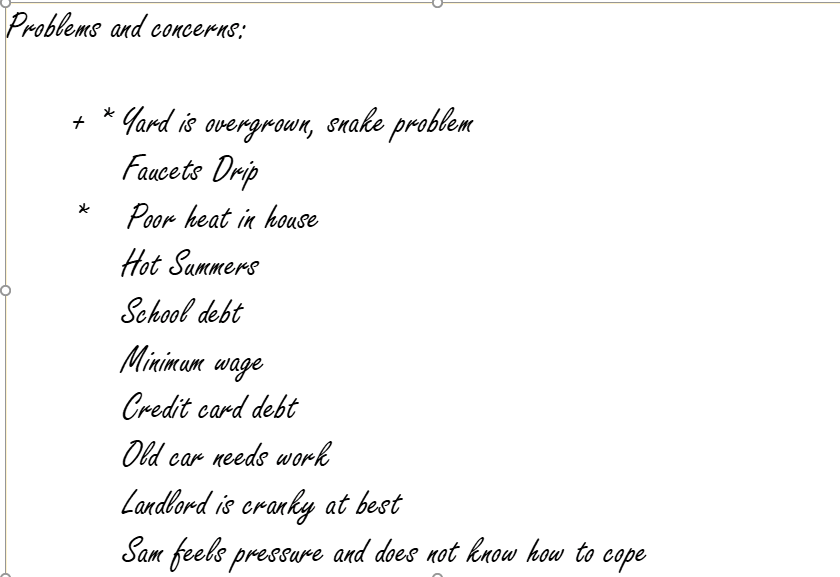
Sam’s list looks like this:

SM'S PRO

+= a safety concern     * = a Health Concern

The big thing to remember when you start looking at problems is that you are not alone.  You may have friends, family, significant others, social clubs, religious organizations, or neighbors. You also have this blog. Please remember that nothing is so horrible it can’t be worked out and good remedies taken. And also, please remember the rules of numbers. One person can be fooled, overtaken, or defeated however some people working as one can easily win the day.

SAM did a pretty neat job on his list. I did notice he left out some of the concerns he had listed earlier.  Although everything gets tackled in an order according to how it affects the overall flow of the home and work, if an item is not on the list, it misses getting considered.  The list will be in great turmoil if it is unnecessarily interrupted.

Please notice that SAM noted safety and/or health concerns.  Putting these issues towards at the top of things to fix helps to save money and heartache in the long run.

Did you leave anything off your list?  It is better to acknowledge a concern than to ignore it.  Ignored items have a tendency to come back and get us.

Consider this and tomorrow we will help SAM (who will have a complete list ready) to plan his order of attack on the problems and have some solutions ready to go.

I think you are really going to like the actions and ideas SAM and his friends have in store for tomorrow.

Thanks for being with us today.

SAM

Today, I am giving you the case study of SAM. SAM is in all caps to distinguish him as an avatar. SAM is an avatar I use to demonstrate how tools work.  I like to use avatars because no one wants me to put their real information out to the public

I am often asked, who do I write for and who do I design my courses for. The people who ask these questions often want to know the age, gender, what the people had for dinner last Tuesday night, and specific problems of my students. I am not sure that that truly captures the people I work for and with.

I am writing for people who find themselves wishing or needing a transition from one stage to another in life. For the majority of people, you might say, someone over 55 is looking to transition from full-time work to retirement and possibly part-time work or a business of their own. For those between 38 and 43, the desire is often a new profession. For those between 26 and 32, there is a desire to ensure they are on the right path to their goals in life. And, those just exiting formal training for the first time, whether high school or college, want to ensure they emerge successfully into the job market.  I promise to share case studies for each of these as time goes on. I just want to remind you that we are people and not statistics.  Some people do different things at different times.  That is all right.  It is known as being human.

For now, we are going to start with Sam who graduated college at age 24, is about to turn 26 and finds himself unhappy, frustrated, and unable to find a path to where he wants to go in life. Finances, location, lack of local employment, and other factors all play into this. Yet SAM is lucky because SAM has friends, and friends know how to find the paths.

SAM

Sam’s Background

Sam is a regular guy from Any-town, USA.  He just graduated college about a year and a half ago. He married his high school love and got one of the few jobs the town had to offer, a food service worker, at the Dairy Duke.

Sam wants to be a writer. He wants the American dream. Unfortunately, a new family in a small town just starting out life finds there are many hurdles to overcome before dreams start to come true.

Sam’s not happy because he can see that he and his wife are not going anywhere and seems not to be able to find a better path. Sam’s wife isn’t happy, she thought marriage was going to be bliss. Sam’s mother-in-law likes Sam, yet she wants to see him reach out and do something for himself and her daughter.

A couple of friends who were studying process improvement offered a game or two which might help Sam out and help him and his wife to find their path. Sam was not sure at first; however, when his car refused to start for the third time in a month, he figured, “what do I have to lose.”

The team came over to his house and talk to the assembled folks. Sam had invited his mother-in-law, and his sister-in-law tagged along to see what was happening. The team explained about what they were learning in school and offered their services for free to help Sam and his wife find their way.

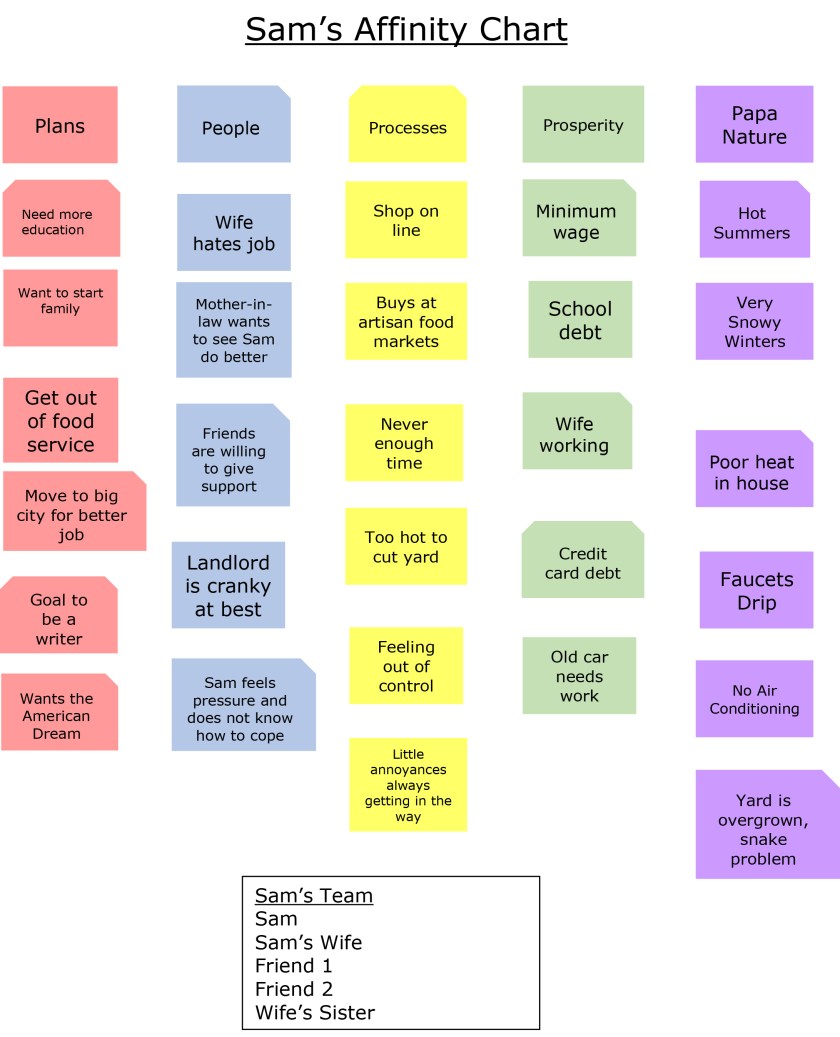
After talking for a little a while, the team played the affinity game with them to see how everybody felt and what problems there might be. And yes, there were some problems.

Sam's Affinity chart


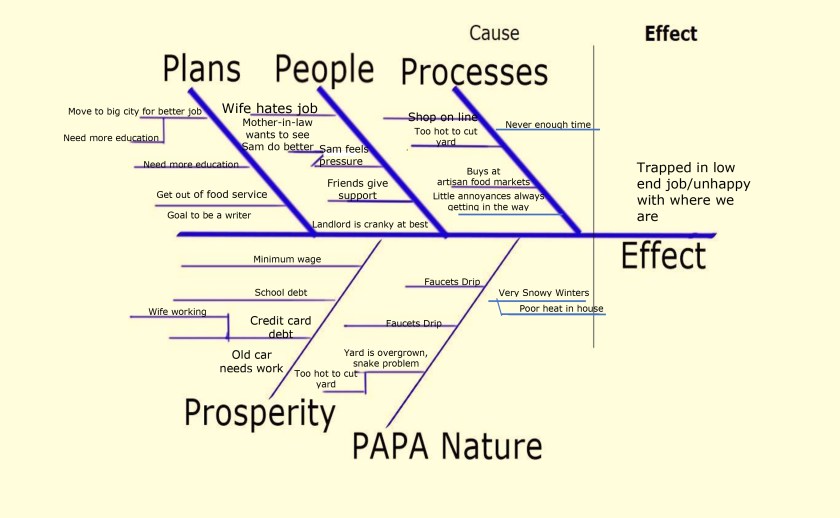
Everybody had fun with the affinity game, and new ideas started to spring up. The infinity game (chart above) led to a Fish-bone diagram (below) which led to many other interests. I would tell you more now, except that may spoil some of the things to come. Therefore, we will start by taking a look at the affinity chart, and the Fish-bone diagram and that will start us on the way to helping to solve Sam’s problems.

Sams Fishbone

Tomorrow we will press on and see where this leads.


On this day, we celebrate the Declaration of Independence

Hi, because today is a holiday, I wanted to pass along this holiday note for the fourth.  We continue our normal blogs tomorrow.

Long distance relationships almost never last.  Mine did not last, although we are still good friends.  The relationship between England and the American Colonies did not last, although Britain and the United States are the best of friends now.

On this day, we celebrate the Declaration of Independence. Actually, it was signed on the second of July.  With no mass communications and no copiers in 1776, it took a couple of days to write copies and to get the word out.

It makes me wonder.  If long distance communication were available at that time, would it have made a difference?  Money is the root of many breakups. Could, however, the economic problems, between England and the Colonies be settled amicably before they grew so large that the two entities had no choice except the War of Independence and the legal separation, which was akin to a divorce of peoples?

This sounds like an academic quandary to be debated, and yet, we are on the cusp of the exact same problems in the very near future.  The people of Earth are planning to colonize the Moon and Mars.

The distance to the Moon and especially the distance to Mars will test the ability of communications. Not that communications are as slow as the 1700’s, there is a lag time that will start out as a nuisance.

Just as with England and the American Colonies. When the colonists of the Moon and Mars mine their ores, their focus will be on their work and not as much on the massive cost the Earth spent to get them to their colonies and provide for them as they began.  The Earth, like England, may be in a rush to reclaim the money spent to set up the colonists.

Special care needs to be planned for the missions to ensure a premium is placed on collaboration and communication.  These must be real communication and collaboration processes, not just buzz words.

Understanding what lead up to the Declaration of Independence 241 years ago is vital to future plans of colonization.  George Santayana reminded us why, when he said, “Those who cannot remember their past are condemned to repeat it.” (Wikipedia, last updated, 2/13/2006)

A special thank you to Paul Nielsen for his discussions and suggestions on this blog.  Thank you.

The Affinity Game

Howdy!

I am very proud of all my sons.  They have each graduated college and are doing fantastic in their fields of endeavor. Especially my son who is a Ph.D. and a tenured college professor. I was amazed that he was published three times as an undergraduate. In all three times, the papers dealt with games. I knew I should’ve stayed in college. That is okay I am developing some new games that we can play.

I hope you were with us in our last session when we discussed and went through a scenario on solving a problem and overcoming a Band-Aid fix.

Every time you have a problem pop up, and is reoccurring, it is developing what we call a hidden factory within your normal life. The hidden factory is something you don’t normally plan on, and yet it happens. Hidden factories steal time and money.  Usually both.

Sometimes we have so many small problems that keep vying for our attention, we don’t know which one to fix first. Sometimes we end up focusing on a small set of problems that are annoyances while missing either more costly problems or items that may be safety issues.

To help keep the larger problems from creeping up on us from behind, it is good to keep an eye on them, and even rank order what you need to fix first and what may be able to wait a little while until you have a better time or better money. To do this, you can play a game with an affinity chart. You can get the whole family, significant others, and/or friends involved in this. I like to make a party out of the affinity game. Have some soda and popcorn or some coffee and cake, or just good friendship. The game requires some post-it notes, a place you can put the Post-it notes, and something to write on them with.

This is a problem hunting game. Think of it this way, what items are giving me grief, taking my time, or taking my money? If I want to save time and money, I need to identify them and start to fix them. If there is something that would cause harm, or flood the house, I want to fix that one first. If I have a screen that is loose, I do want to fix that, I just may need to fix something else first.

In the affinity game,  use five headings.  The headings are People, who are those who are affected, family and/or friends. Plans, they are the overall goals, not just the problems. Processes, how we do things such as pay bills, buy groceries, etc.. Prosperity, the paycheck and other resources we use. Lastly, Papa Nature, the environmental concerns such as living in tornado alley or near a flood plain. You want to write these five areas on separate Post-it notes and place them on a whiteboard, a wall that won’t be marred, or some other flat surface where you can put plenty of other Post-its below each one.

To start out, go around the room, and each person puts one Post-it note under a heading with one item they think could be done better. Just list the item. Don’t give ideas for fixes or long written descriptions now. It is probably good to have somebody act as the facilitator for this. You could even spark interest by having the child or teenager be the facilitator. The facilitator also places post-its on the chart when it is his or her turn.

If more than one person hands in a Post-it note with the same item or nearly the same item on it, that is okay. Put those Post-it notes on top of each other. The fact that there are multiple Post-it notes shows a deeper concern in that area.

You can limit the affinity game to an hour, or you can keep on going until no one else has anything that they can think of to put on a Post-it. The more Post-its, the better because you’re getting ideas out there. And every idea is of value to the person who had it. Every person is also valuable to the family or team as a whole.

When the game is done, everybody should thank each other and tell each other that everyone is important to the family or the team. The nice thing is now you have information.

You have gathered data. It is believed, and talked of, and is yet to be proven. It is, however, valuable data because it is a start.

Next time we will take what has been learned here with the affinity diagram and learn how to use it in our next step.

Thank you for being with us.

Everybody loves to learn something new

Everybody loves to learn something new. It makes us feel good to know something new. Learning keeps us young in heart and soul. Although we love to learn, no one likes to be taught. There are several negatives which have a tie to being poorly taught. My goal is not to teach you. My goal is to help you learn.

As soon as you mention things such as TQM, 8 – D, Six Sigma, or any of the other quality and process improvement techniques, you automatically find yourself the only person standing in the room. Everyone else ran. Most hate these classes.

Everyone who was ever ordered to take a process improvement class has a right. And everyone who wasted time sitting through endless meetings trying to figure out something to change has a right. And, all those who put up with the corporate politics of leaders who would never let the change happen, has a right to hate the subject.

We are not going to do that here.

You are a smart person. And you are responsible. Everybody has different responsibilities. You may have a house or an apartment, a family and/or a pet, and bank accounts and credit cards which you maintain. You are pretty good at the things you regularly do. And you’re probably a whiz at some others. Don’t let anyone put you down.

Everybody has things that go well and things which tend to go off the rails from time to time. I’m here to show you a few ideas you can learn to do, which will keep the same thing from going off the rails every six weeks or so.

Ever have a small problem that interrupts the momentum of your morning? For me, about once every six weeks I can’t find my car keys. When I come back to look for them, I am accused of losing them for good, and we will never be able to drive the car again!

They usually have fallen out of my pants pocket. Or, were left in a jacket or pants which I had used the day before. On rare occasions when I’m carrying things in both hands they end up left stuck inside the front door knob overnight. Good thing I lock the screen door.

To this annoyance, I usually apply what’s known as a Band-Aid Fix. Something super fast, super cheap, and something allows for the annoyance to be ignored until the next time it happens. The bad thing about this type of a fix is that it guarantees whatever the annoyance is it will happen again, and probably sooner than later.

My Band-Aid Fix to this is to set out a bowl on a table or nightstand which I plan to put the contents of my pockets into nightly. How often does this actually happen? Usually, the first night I set the bowl out and occasionally the second. I’m not a bad person, I just get busy and forget. Therefore, it is only a Band-Aid cure and guaranteed to happen again at regular intervals.

Because I work for myself (I think that is called a vow of poverty,) I have time to look for the keys. If I had to be somewhere at a particular time, I could be in trouble. So what is a better thing that I could do to ensure I knew exactly where my keys are first thing in the morning?

Are we going to write a long and lengthy process and perform follow up on it every six months? Absolutely not! What’s the smart thing to do? Because it’s my wife and me, we could take a few minutes and think about it.

Some ideas could be as simple as having a key rack with hooks by the door, where I place my keys when I come home and take them when leaving. The key rack could be in plain sight so we could both keep an eye on whether or not we were using it.

Another option, we could hide keys outside the house because if the keys are hanging inside the house, sooner or later, we will end up locking ourselves out. Unfortunately, neither one of us are trusting enough souls to hide keys outside the house.

Another option might be to purchase a key finder. Amazon has a plethora of key finders that work with everything from a whistle to your smartphone. Cost is usually somewhere between $15, and $24.  There are more expensive and less expensive models.

So on a five-minute conversation with your significant other, (maybe 10 minutes,) you discuss the situation with someone and come up with three good ideas. Which is best? It’s not for me to say, it is whichever method is most foolproof for you. Usually, the best processes remove human intervention.

Just a side note, when I can’t find my smartphone, I use the house phone to call the smartphone, and then I walk around the house trying to hear it ring. Always great to have a backup.

Thank you for being with us today.  Until next time, we wish you well.

Ever Play 20 Questions?

When you were a kid did you ever play 20 questions? It was a fun game to help pass the time. It basically worked by everyone agreeing on a topic (person, thing, activity, etc.) One person would pick something based on the topic. Everyone else playing the game would ask the person questions for a yes or no answer. A few years ago, an electronic game of the same name, and played the same way was a hit in the marketplace as a holiday gift.

Today, I promised you forests of decision trees, and here I am talking about games. The neat thing is, the 20 questions game is the same decision matrix which is used in the decision tree. You ask a series of questions for which there can only be a yes or no answer. You do need to verify the answers as you go. This, though, is often the easiest, and smartest way to discover root cause, or help you decide on a course of action.

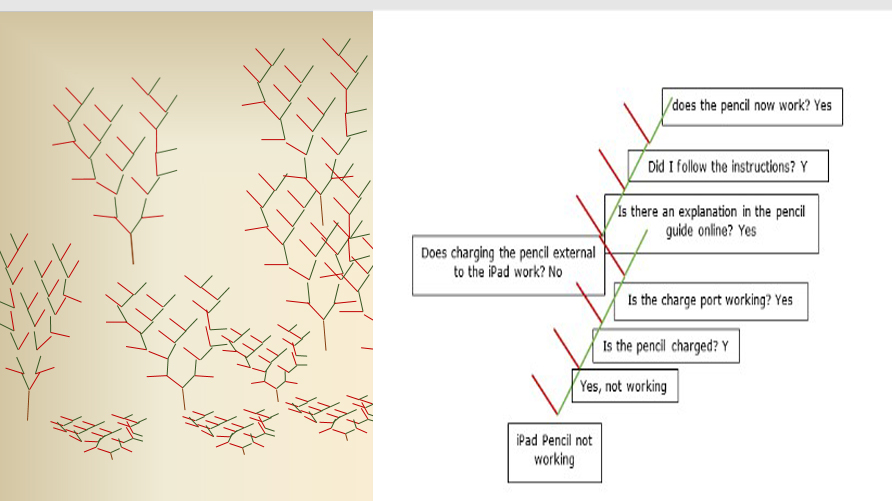
If you look at the trees, each junction has two branches. A red branch which we will call the ‘No’ branch, and, a green branch which we will call the ‘Yes’ branch. It is always good to draw your decision tree as you go.

You can do this in your notebook, on a whiteboard, on your computer, on a tablet, or on your smartphone, depending on what type of software you have loaded. I like to put mine either in my tablet or in my notebook so I can refer to the decision tree later.

Remember, a no is not always the end of a line of questioning. You can explore a no route, although it is often easier and more correct to follow the yes trail. By doing so, you stay on a positive path. If you do this, ask the questions in a way that yes leads you on, and no helps you to eliminate something. In that case, and it is the case I recommend, your tree will look like the one on the right above.

Let’s run a practice decision tree just to test one out. This is something that happened to me last night, and although I did not draw the decision tree at the time, these are the steps I took.

Last night the pencil to my iPad did not work, I was frustrated. It cost hundred dollars, and I was in no mood, nor prepared to buy another one. So this means I had to figure out why and make the pencil work again. This decision tree will be the one on the right, not the forest on the left.

  1. Is the pencil not working properly? Yes, not working
  2. Is the pencil charged? Yes (I charged the pencil for 15 minutes to ensure it was charged.)
  3. Is the charge port working? Yes (I could charge the iPad)
  4. Does charging the pencil external to the iPad work? No (tried it, this means it’s not the charging port)
  5. Is there an explanation in the pencil guide online? Yes (I followed the instructions)
  6. Does the pencil now work? Yes

I learned new things last night. I also learned not to be the cliché of the guy who reads the instructions only as the last step. Next time, I will move reading the instructions further up the list.

Whether I do it consciously or subconsciously, I like the decision trees.


Enjoy Each Moment for Where You Are

Morning. I hope everybody had a wonderful weekend.

Last week we mapped out a set of goals and milestones. Before we move on to our next round of ideas and workshops, I would like to give one more thought on reaching your goals. I wish to do this because many people look at the goal as the end. As you get to your goal, you’re going to find out, most likely, that the goal you have reached is merely the stepping stone to the next and even greater thing.

It seems that in nature and in life nothing is as simple as start-middle-end. For as each end is seen, new beginnings emerge. And, as new beginnings emerge they denote the end of something in the past.

And yet, not really, for when there are new beginnings. It is more flow from one thing to the next. The flow is natural and it is to be expected. I’m not telling you something as simple as go with the flow.  And, I know it’s a cliché to say each ending is a new beginning. I guess what I’m trying to say is everything is continuous. Therefore, enjoy each moment for where you are and who you are with.

Tomorrow, we are going to look at forestry, in a sense. We are going to grow a forest of decision trees. Decision trees are great, and they will help you in making some tough decisions, sometimes.

Please enjoy today, and we look forward to tomorrow’s discussion.

Thanks for being with us.